



September 25, 2026




TL;DR:
- Strategic marketing aligns efforts with long-term business objectives through research, targeting, and value propositions.
- Frameworks like SWOT, STP, and Ansoff guide deliberate growth and market positioning decisions.
- AI enhances personalization and efficiency but depends on strong data foundations and leadership clarity.
Many businesses treat marketing as a series of disconnected tasks, posting on social media one week, running a paid ad the next, and wondering why growth remains unpredictable. That confusion between tactics and strategy is one of the most common and costly mistakes business leaders make. Strategic marketing is a long-term, systematic process that aligns marketing efforts with business objectives. This article walks you through the core principles, proven frameworks, AI-powered tools, and real-world applications that distinguish genuine strategy from short-term guesswork.
Table of Contents
- Understanding strategic marketing: Foundations and principles
- Strategic marketing frameworks: Tools for effective planning
- AI-powered strategic marketing: Personalization and efficiency gains
- Applying strategic marketing: Real-world examples and digital focus
- A fresh perspective: What most guides miss about strategic marketing
- Supercharge your strategic marketing with expert support
- Frequently asked questions
Key Takeaways
| Point | Details |
|---|---|
| Strategy drives growth | Strategic marketing aligns business goals and marketing efforts for sustained success. |
| Frameworks guide action | Tools like SWOT and STP enable focused, data-driven decision making in marketing. |
| AI enhances efficiency | Integrating AI leads to smarter personalization and measurable improvements in marketing performance. |
| Action brings clarity | Applying strategic principles in digital channels delivers real competitive advantage. |
Understanding strategic marketing: Foundations and principles
Now that we’ve set the stage, let’s clarify what strategic marketing really means and why it’s more than just tactics.
Most business leaders understand what marketing does, but far fewer understand what strategic marketing is. At its core, strategic marketing is a long-term, systematic process that aligns marketing efforts with business objectives, involving market research, target audience identification, value proposition development, and marketing mix strategies. It’s not a campaign. It’s not a channel. It’s a deliberate system designed to create sustainable growth.
Consider the difference between running a Google Ads campaign and developing a customer acquisition strategy. The campaign is a tactic. The strategy defines who you’re targeting, why they should choose you, what message resonates, and how every channel reinforces that message over time. One is reactive; the other is intentional.
The core components of strategic marketing include:
- Market research: Understanding your industry landscape, competitors, and customer behavior through data rather than assumptions.
- Target audience identification: Narrowing your focus to the customers most likely to convert, retain, and refer others.
- Value proposition development: Clearly articulating what makes your offering uniquely worth choosing.
- Marketing mix strategy: Coordinating product, price, place, and promotion decisions in a way that supports your long-term position.
A common misconception is that strategy means complexity. In practice, the clearest strategies are often the simplest. They answer three questions with precision: Who are we serving? What problem are we solving? Why are we the best option? When those answers are clear and consistently communicated, every marketing action becomes more effective because it’s anchored to something real.
Another misconception is that strategy is only for large enterprises. In reality, small and mid-sized businesses benefit even more from strategic clarity, because they have fewer resources to waste on misdirected efforts. A well-defined strategy tells you not only what to do, but what to stop doing.
“Strategy without tactics is the slowest route to victory. Tactics without strategy is the noise before defeat.” This principle, often attributed to Sun Tzu, captures exactly why so many marketing budgets fail to produce results.
Pro Tip: Before investing in any new marketing channel, ask whether it directly supports a documented business objective. If you can’t answer that clearly, the channel isn’t ready to be activated.
Strategic marketing also intersects deeply with content and media. For example, video marketing strategies are most effective when they serve a defined audience segment with a specific message, rather than being produced for general awareness. That’s strategy in action.
Strategic marketing frameworks: Tools for effective planning
With the foundational principles in place, let’s explore the proven frameworks that underpin strategic marketing planning.
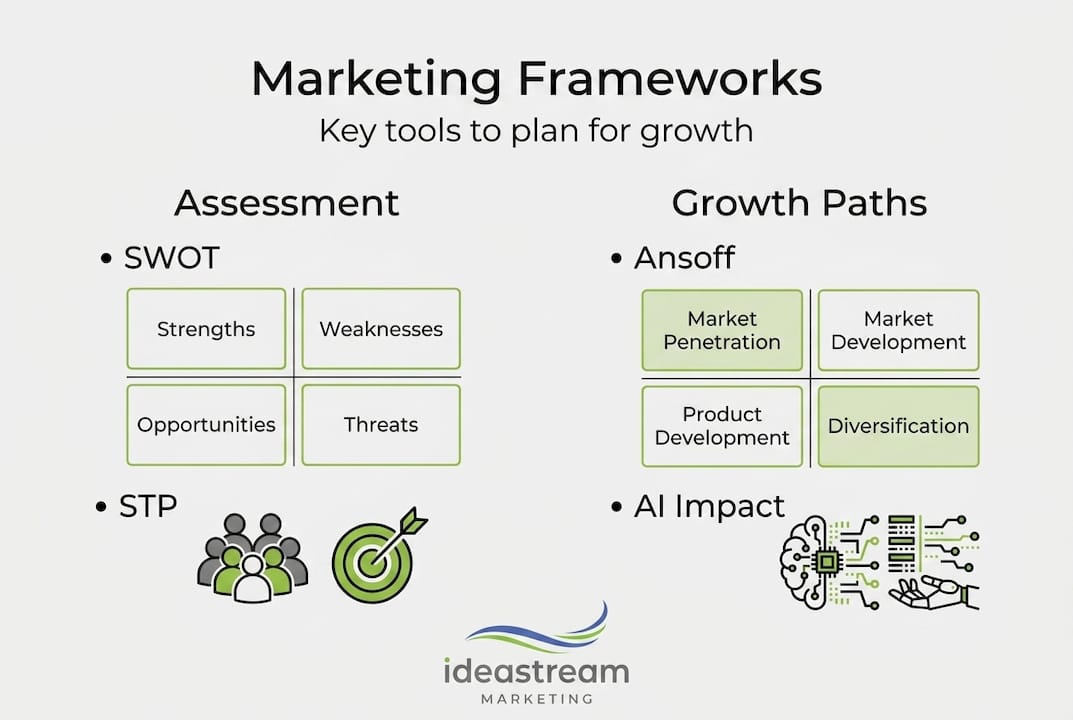
Frameworks give structure to strategic decisions. They help you organize information, identify gaps, and prioritize actions based on evidence rather than instinct. Frameworks like SWOT, STP, and the Ansoff Matrix guide strategic decisions at every stage of business growth, from launch through scale.
Understanding the three core frameworks:
| Framework | Primary Use | Best Applied When |
|---|---|---|
| SWOT Analysis | Situational assessment | Starting a strategy or entering a new market |
| STP Model | Audience and positioning | Refining targeting or repositioning a brand |
| Ansoff Matrix | Growth planning | Evaluating expansion options with calculated risk |
SWOT Analysis examines your Strengths, Weaknesses, Opportunities, and Threats. It’s a structured way to assess where your business stands before making strategic commitments. A professional services firm, for example, might identify its depth of expertise as a strength, its limited online presence as a weakness, increased demand for remote consulting as an opportunity, and low-cost competitors as a threat. That snapshot informs every subsequent decision.
The STP model (Segmentation, Targeting, and Positioning) is arguably the most practical framework for marketers. It works in three steps:
- Segment your market by breaking the broader audience into distinct groups based on demographics, behavior, geography, or psychographics.
- Target the segments that offer the highest potential return and alignment with your capabilities.
- Position your brand within the chosen segment by crafting a message that speaks directly to that audience’s needs and motivations.
For a healthcare practice targeting patients over 55 in a suburban market, STP would shape everything from the tone of website copy to the platforms used for paid advertising.
The Ansoff Matrix maps four growth strategies on a 2×2 grid. Market penetration (existing products, existing markets) is the lowest risk. Product development (new products, existing markets) requires more investment. Market development (existing products, new markets) involves geographic or demographic expansion. Diversification (new products, new markets) carries the highest risk but also the highest potential reward. This framework helps leaders choose growth paths deliberately rather than reactively.

Pro Tip: Use SWOT first to understand your starting position, then apply STP to clarify your audience, and use the Ansoff Matrix to choose the growth strategy your resources can actually support.
Exploring essential marketing strategies alongside these frameworks gives you a fuller picture of how planning translates into execution. When frameworks are used consistently, they create a foundation for scalable growth rather than one-off wins.
AI-powered strategic marketing: Personalization and efficiency gains
Understanding planning tools is vital, but integrating digital and AI capabilities takes strategic marketing to a new level.
Artificial intelligence is no longer an emerging trend in marketing. It’s a functional reality that’s reshaping how brands plan, execute, and optimize their strategies. The question isn’t whether you should use AI in your marketing, but how to use it strategically so it amplifies your existing strengths rather than introducing new confusion.
There are two types of AI that matter most for strategic marketing right now. Generative AI creates content, such as ad copy, email sequences, landing page text, and social media posts. It can produce variations at scale, enabling rapid testing and personalization. Agentic AI goes further, autonomously executing multi-step marketing tasks like lead nurturing workflows, campaign adjustments, and performance reporting without requiring constant human input.
Gen AI enhances strategy via personalization with a 22% efficiency gain, but it requires strong data foundations to function effectively. Agentic AI is beginning to shift the CMO role from tactical oversight to strategic architecture, where leadership focuses on setting objectives and reviewing outcomes rather than managing individual campaign elements.
Key efficiency and personalization gains from AI include:
- Delivering personalized content at scale across email, social, and paid channels based on real user behavior data.
- Automating A/B testing so the highest-performing message is served without manual analysis.
- Predicting customer lifetime value and churn risk based on behavioral patterns.
- Generating real-time performance insights that allow faster strategic pivots.
- Segmenting audiences dynamically as new data comes in, eliminating static audience lists.
AI marketing capabilities at a glance:
| AI Type | Function | Business Impact |
|---|---|---|
| Generative AI | Content creation and variation | Faster production, scalable personalization |
| Agentic AI | Autonomous task execution | Reduced manual oversight, strategic focus |
| Predictive AI | Forecasting and scoring | Better targeting, lower customer acquisition cost |
The critical factor that most businesses overlook is data quality. AI is only as effective as the data it learns from. If your CRM is incomplete, your tracking is broken, or your audience segments are poorly defined, AI tools will amplify those weaknesses rather than fix them. This is why data infrastructure is a strategic priority, not a technical afterthought.
Our AI marketing strategy guide walks through exactly how to build that foundation and integrate AI in a way that supports your long-term objectives.
Efficiency callout: Businesses that integrate AI personalization into their marketing workflows report up to a 22% gain in efficiency, meaning the same team can accomplish significantly more in less time.
Applying strategic marketing: Real-world examples and digital focus
We’ve covered the tools and AI impact. Now, it’s time to see how real companies put strategic marketing into action in digital spaces.
Strategy without execution is just planning. The most effective business leaders treat strategy as an ongoing practice of choosing what to prioritize and, just as importantly, what to set aside. Some experts define marketing strategy as “the art of choice,” specifically what not to do, while others emphasize AI integration as the primary path to competitive advantage in uncertain markets. Both perspectives are correct, and they complement each other.
Consider a professional services firm launching in a competitive regional market. A purely tactical approach might mean running ads and posting regularly on LinkedIn. A strategic approach begins with a defined audience (mid-sized companies in regulated industries), a differentiated value proposition (deep regulatory expertise with faster turnaround), and a content strategy that proves that expertise through case studies, webinars, and targeted email sequences. Each tactic is chosen because it supports the strategic position, not because it’s popular.
Where strategic marketing plays out in digital channels:
- Search and SEO: Content is built around the specific questions your target audience asks, not generic keywords, ensuring you attract qualified traffic with genuine intent to buy.
- Social media: Platform selection is strategic. A B2B firm that tries to win on TikTok without evidence its audience is there is wasting resources. A hospitality brand ignoring Instagram is leaving visual storytelling opportunities on the table.
- Email marketing: Email remains one of the highest-ROI digital channels because it allows direct, personalized communication at scale. A strategic email program segments by behavior, not just demographics.
- Video: Video is now essential for building trust across industries. Effective video marketing examples show how brands use short-form and long-form content to educate, differentiate, and convert in ways that text alone cannot achieve.
- Paid advertising: Strategic ad campaigns are built around the buyer journey, not just clicks. A cold audience needs awareness-level messaging. A retargeted audience needs conversion-focused offers.
Pro Tip: Map each digital channel to a specific stage of your customer journey. If a channel doesn’t clearly serve awareness, consideration, or conversion, it shouldn’t be in your plan.
To learn how to boost digital ROI through integrated channel planning, or to get a clearer picture of the full landscape of types of digital marketing available to growing businesses, the key takeaway is consistent: every channel decision should trace back to a strategic objective.
The companies seeing the strongest results in 2026 aren’t the ones using the most channels. They’re the ones using the right channels with clear purpose, well-defined audiences, and consistent messaging across every touchpoint.
A fresh perspective: What most guides miss about strategic marketing
Most strategic marketing guides focus on what to do. Far fewer address the harder question: what should you stop doing, or never start in the first place? Real strategy is about trade-offs. It’s about recognizing that spreading budget and attention across every available channel is not ambition. It’s a lack of discipline that produces mediocre results everywhere.
We’ve worked with businesses that have impressive marketing stacks but no coherent strategy tying them together. The data exists, the tools are running, but no one has asked the foundational question: “Which customers are we trying to attract, and why would they choose us?” That’s where strategy begins. Not with tools, not with platforms.
The other overlooked factor is leadership clarity. AI can process data and automate execution, but it cannot define what a business stands for or what trade-offs are worth making. Those are human judgments. Full-service agency insight reveals that the businesses achieving the most consistent growth are those where leadership is involved in strategic marketing decisions, not just reviewing monthly reports. Strategy requires judgment, and judgment requires people who understand the business deeply.
Don’t let the pace of AI innovation push you toward constant adoption of new tools before your fundamentals are strong. Get clear on your audience. Build your data infrastructure. Define your position. Then let AI amplify what’s already working.
Supercharge your strategic marketing with expert support
Putting strategic marketing into practice requires more than frameworks and good intentions. It takes the right expertise, integrated tools, and consistent execution across every digital channel.
At Idea Stream Marketing, we specialize in building strategic marketing systems that drive real, measurable growth for businesses across the United States. From digital marketing solutions that integrate SEO, paid media, and content to AI enhanced marketing programs built on solid data foundations, we bring the structure and expertise your business needs to compete with confidence. Whether you’re building a strategy from scratch or optimizing what you already have, our team is ready to help. Connect with us to start the conversation.
Frequently asked questions
How is strategic marketing different from tactical marketing?
Strategic marketing focuses on long-term goals and aligning all efforts with core business objectives, while tactical marketing addresses short-term campaigns and individual actions that support the broader strategy.
What are the main frameworks used in strategic marketing?
The most widely used frameworks are SWOT, STP, and the Ansoff Matrix, each serving a distinct purpose in planning, audience targeting, and growth decision-making.
How does AI impact strategic marketing today?
AI tools, particularly generative and agentic types, deliver up to 22% efficiency gains through personalization and automation, but strong data infrastructure is essential to getting real value from them.
What should business leaders prioritize when developing a strategic marketing plan?
Start with clear business objectives, define your target audience precisely, establish a differentiated value proposition, and then select frameworks and channels that align with those priorities before introducing any new technology.
Can strategic marketing be applied to small businesses or startups?
Absolutely. Strategic marketing frameworks scale to any business size, and smaller organizations often benefit the most because clear strategy prevents wasted spending and keeps limited resources focused on the highest-impact actions.