



September 30, 2026




TL;DR:
- Content marketing is a strategic, long-term approach focused on creating valuable, consistent content.
- Owned channels like blogs and email generate lasting leads and build authority over time.
- Combining AI tools with human expertise enhances content quality and engagement for SMBs.
Most business owners think content marketing means writing a few blog posts or staying active on Instagram. That’s a common misunderstanding, and it costs them real growth. Content marketing is actually a strategic approach focused on creating and distributing valuable, relevant, and consistent content to attract and retain a clearly defined audience, ultimately driving profitable customer action. For small and medium-sized businesses (SMBs), getting this right isn’t optional. This article walks you through why content marketing works for SMBs, how to build a solid framework, the role of AI tools, and how to measure results.
Table of Contents
- Why content marketing matters for SMBs
- How content marketing works: Framework and core strategies
- The role of AI and human expertise in content creation
- Tracking ROI and measuring success in content marketing
- Why authenticity outperforms big budgets in SMB content marketing
- Ready to elevate your content marketing strategy?
- Frequently asked questions
Key Takeaways
| Point | Details |
|---|---|
| Consistency builds results | Publishing valuable content regularly drives compounding lead and traffic growth for SMBs. |
| Quality over quantity | Focusing on niche expertise and human-edited content leads to better engagement than mass-produced posts. |
| Track what matters | Measure attribution for leads and revenue to justify your content marketing investment. |
| AI plus human equals impact | Use AI for efficiency but always add human oversight for higher-quality outcomes. |
Why content marketing matters for SMBs
Many SMB owners assume content marketing is a luxury reserved for brands with large teams and bigger budgets. That assumption leads to missed opportunities, because the strategic advantage of content actually favors smaller, more focused businesses.
Here’s why. A local accounting firm that consistently publishes helpful tax planning articles builds an audience of loyal readers over time. Each published article becomes a searchable asset that keeps working long after publication. This is what marketers call the compounding effect. Unlike paid ads that stop the moment your budget runs out, well-crafted content generates traffic and leads for months or even years.
“For SMBs, the smartest move isn’t outspending competitors. It’s out-niching them. Leverage your expertise, focus on compounding assets like blogs and email, and prioritize owned channels that you control.” — SMB Content Strategy Guide
The numbers back this up. SMBs that blog consistently generate 67% more leads than those that don’t. That’s a significant competitive edge, especially for businesses operating with limited marketing resources.
Consider these core advantages for SMBs specifically:
- Owned channels build lasting equity. Your blog and email list are assets you control. Social media algorithms change constantly, but your subscribers and search rankings belong to you.
- Niche expertise beats budget size. A specialty landscaping company can produce deeply specific content that a national chain simply won’t prioritize. That specificity attracts the right customers.
- Content compounds over time. A single evergreen blog post can attract leads for years, making the cost per lead drop significantly the longer it stays active.
- Repurposing multiplies value. One well-researched article can become a newsletter, a social post, a short video, and a FAQ section on your website, all from a single content investment.
Working on strategic marketing for SMBs requires recognizing that consistency, not volume, drives long-term growth. If you’re just getting started, reviewing small business marketing tips can help you prioritize which content types to focus on first.
How content marketing works: Framework and core strategies
Understanding why content marketing matters sets the stage for learning how it actually works and what steps are involved. Without a clear framework, even the best intentions produce scattered results. Here’s how to build a system that delivers measurable outcomes.
Step 1: Define your audience personas and content goals.
Before writing a single word, know exactly who you’re writing for and what you want them to do. A persona captures your ideal customer’s job title, daily challenges, and what questions they type into Google. Your content goals should connect to business outcomes, such as generating 20 qualified leads per month or reducing customer service calls by answering common questions in your content.
Step 2: Audit what you already have.
Most SMBs overlook this step. Before creating new content, review what’s already published. Identify what’s performing well, what needs updating, and what should be removed. Refreshing an existing high-ranking article often outperforms publishing something brand new.
Step 3: Build pillar content and supporting pieces.
Pillar content is a detailed, authoritative article or page that covers a broad topic thoroughly. Supporting pieces are shorter articles that address specific subtopics and link back to the pillar. For example, a financial advisor might create a pillar page on retirement planning and support it with articles on Roth IRAs, Social Security timing, and market volatility strategies. According to SMB content strategy research, this structure improves SEO visibility and establishes your brand as a trusted authority in your niche.

Step 4: Distribute across email, social, and owned platforms.
Publishing is only half the job. Distribution determines how many people actually see your content. Email newsletters push content directly to subscribers who’ve already shown interest. Social media amplifies reach to new audiences. Your website, of course, is the hub where everything lives and where search engines can find and rank it.
Step 5: Track leads and return on investment (ROI).
Track multi-platform content reach using tools like Google Analytics, your email platform’s reporting, and a CRM (customer relationship management) system. Measure which content pieces drive the most traffic, generate the most leads, and ultimately convert visitors into customers.
Here’s a quick comparison of common content formats to help you decide where to start:
| Content type | Best for | Average time to produce | ROI timeline |
|---|---|---|---|
| Blog articles | SEO, lead generation | 2 to 4 hours | 3 to 12 months |
| Email newsletters | Retention, nurturing | 1 to 2 hours | Immediate to 30 days |
| Short-form video | Awareness, social reach | 3 to 6 hours | 1 to 3 months |
| Case studies | Trust, conversion | 4 to 8 hours | 1 to 6 months |
| Infographics | Education, shareability | 3 to 5 hours | 1 to 6 months |
Pro Tip: Start with blog content and email as your foundational channels. Both are owned assets that you control completely. Once those are running consistently, add video or social content to expand your reach without adding unnecessary complexity.
The role of AI and human expertise in content creation
With the core strategies covered, it’s time to examine how technology and expertise combine to shape results. AI tools have changed the content creation landscape significantly in the past two years. But using them effectively requires understanding both their strengths and their limitations.
AI excels at certain tasks. It can generate first drafts quickly, suggest topic ideas based on keyword research, summarize long documents, and help repurpose existing content into different formats. For an SMB with a small team, AI can dramatically increase the volume of content produced without a proportional increase in cost or time.
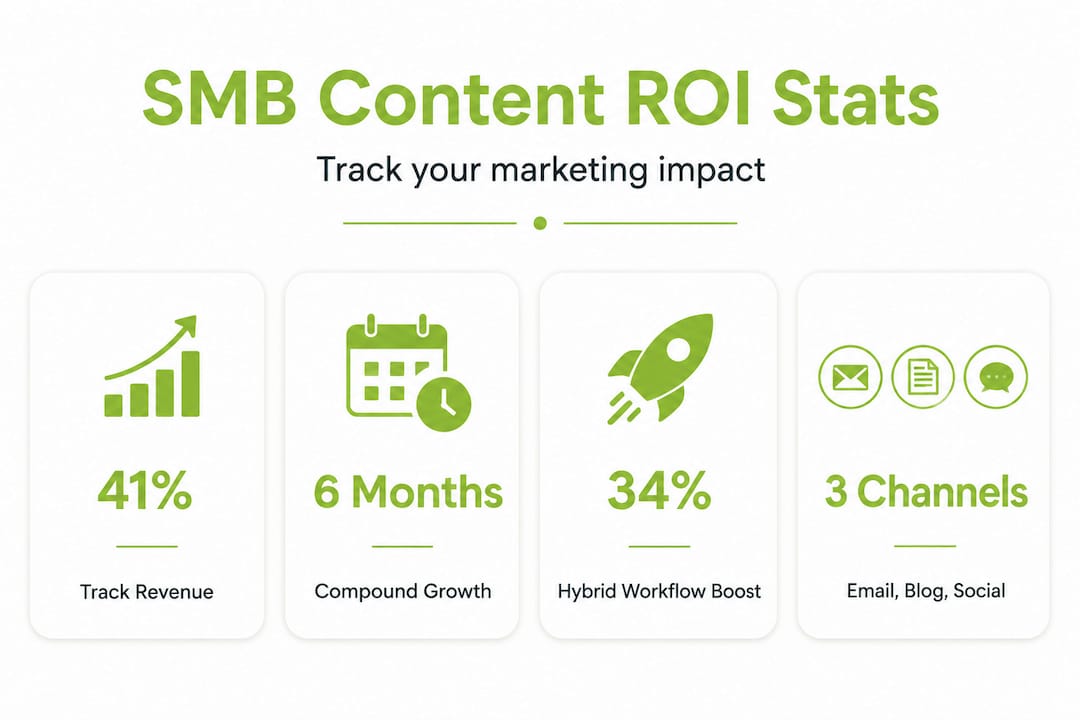
However, volume alone doesn’t win in content marketing. Quality and authority matter far more. Research shows that hybrid content creation (where AI drafts and humans edit) produces 34% better engagement than fully AI-generated or fully manual content. That number reflects a real pattern: AI lacks context, lived experience, and the nuanced judgment that builds reader trust.
“Chasing volume over quality dilutes authority. Viral content doesn’t always mean pipeline. Measure what matters: revenue attribution, not just page views.” — The Marketing Juice
Here’s a practical breakdown of how AI and human expertise divide responsibilities:
| Task | AI role | Human role |
|---|---|---|
| Topic generation | High efficiency, broad ideation | Filters for audience relevance |
| First draft writing | Fast production of structured content | Adds voice, experience, expertise |
| SEO optimization | Keyword integration, meta descriptions | Ensures context and search intent match |
| Fact checking | Limited, prone to errors | Essential review for accuracy |
| Emotional resonance | Weak, often generic | Strong, draws on real client scenarios |
| Performance analysis | Can surface patterns in data | Interprets data in business context |
Exploring an AI-driven marketing guide can help you understand where to integrate these tools into your existing workflow. It’s also worth reviewing how AI transforms digital marketing strategies to see the broader impact on content performance and lead generation.
Another critical point: only 41% of marketers actually measure revenue attribution from their content. This means most businesses are publishing content without truly knowing if it’s generating sales. AI can help analyze patterns, but a human needs to connect those patterns to real business decisions.
Pro Tip: Set up UTM parameters (short tracking codes you add to URLs) for every piece of content you distribute. This tells your analytics tools exactly where leads and conversions are coming from, making it much easier to calculate content ROI accurately.
Tracking ROI and measuring success in content marketing
Knowing how to leverage both AI and human expertise, the next step is learning how to measure the effectiveness of your content marketing efforts. Without measurement, you’re spending time and money without knowing what’s actually working.
Start with these essential metrics:
- Organic traffic. How many visitors are finding your content through search engines? Growth here signals that your SEO strategy is working.
- Lead generation. How many visitors fill out a form, request a consultation, or download a resource? This connects content to real business opportunities.
- Conversion rate. Of the leads generated, how many become paying customers? This reveals whether your content is attracting the right audience.
- Engagement metrics. Time on page, scroll depth, and return visits indicate whether your content is genuinely useful to readers.
- Revenue attribution. This is the hardest metric but the most important. Which specific content pieces contributed to closed deals?
The gap between traffic and revenue attribution is a real problem for most SMBs. As noted earlier, only 41% of marketers measure revenue attribution from their content. If you’re not in that 41%, closing that gap should be a top priority.
Personalization also plays a significant role in engagement. Content tailored to a specific audience segment (for example, a dentist writing for other dentists about patient retention) consistently outperforms generic content on the same topic. Niche audiences respond to language that sounds like it was written for them specifically.
One more factor worth repeating: consistency. Content marketing is not a one-month campaign. Most SMBs see meaningful traffic and lead growth after six or more months of consistent publishing. Set a realistic publishing schedule and stick to it. Even two quality articles per month, sustained for a year, builds more authority than a burst of fifteen articles followed by silence.
For practical strategies on turning these metrics into measurable growth, reviewing resources on boosting digital marketing ROI can clarify which data points to prioritize and how to build a reporting structure that actually informs decisions.
Why authenticity outperforms big budgets in SMB content marketing
Here’s something we’ve observed consistently across SMB clients: the businesses that grow fastest with content marketing aren’t the ones with the largest budgets. They’re the ones that show up authentically and consistently for a clearly defined audience.
Large corporations produce polished, professional content. But polished often means generic. A regional physical therapy clinic that shares real patient recovery stories, written with empathy and clinical accuracy, will outperform a national chain’s glossy brochure content every time. Why? Because readers recognize genuine expertise and lived experience. They respond to it.
Content marketing success comes from being user-focused rather than self-focused. SMBs that write “10 things we do well” will consistently underperform compared to those writing “10 questions to ask your contractor before signing any agreement.” One speaks to the business. The other speaks to the customer.
Personalization separates high-performing SMB content from average content. You don’t need a sophisticated technology stack to personalize. Knowing your audience well enough to write for a specific role, problem, or industry stage is personalization at its most effective form.
Consistency is the real multiplier. Content results compound over six months or more. The businesses we’ve seen succeed with content marketing are those that treat it like a long-term investment, not a campaign. They show up week after week, refine based on data, and keep the audience’s needs at the center.
We also recommend exploring video content marketing as a natural extension of this authenticity-first approach. Short, honest videos from a business owner or team member often generate more engagement than expensive productions, simply because they feel real.
Ready to elevate your content marketing strategy?
Content marketing works when it’s strategic, consistent, and grounded in genuine expertise. If you’ve read this far, you understand the principles. The next step is putting them into action with the right support behind you.
At Idea Stream Marketing, we help SMBs build content systems that generate real visibility and qualified leads, not just page views. Our digital marketing solutions are designed for businesses that need end-to-end strategy, from content creation and SEO to distribution and performance tracking. We also integrate AI-enhanced marketing services to help you scale content production without sacrificing quality or your brand voice. If you’re ready to build a content strategy that actually grows your business, connect with our team and let’s talk about what’s possible.
Frequently asked questions
What types of content work best for SMBs?
Blog articles, email newsletters, and niche-focused content help SMBs attract and engage their target audiences most effectively, as owned channels like blogs and email provide the greatest long-term return on investment.
How long does it take to see results from content marketing?
Most SMBs see noticeable traffic and lead improvements after consistent content publishing for at least six months, because content results compound gradually as authority and search rankings build over time.
Should SMBs use AI tools for content creation?
AI can speed up drafting and idea generation significantly, but human editing improves engagement by 34% in hybrid workflows, making human oversight essential for quality and audience trust.
What metrics should be tracked to measure content marketing success?
Track leads, conversions, engagement rates, and revenue attribution to evaluate effectiveness, though only 41% of marketers currently measure revenue attribution despite it being the most meaningful indicator of content’s business impact.
Recommended
- Lead generation explained: proven strategies for SMB growth | Idea Stream Marketing
- The ultimate digital marketing checklist for SMB growth | Idea Stream Marketing
- Why invest in digital marketing? Maximize growth & reach | Web Design & Marketing Agency
- video content marketing | Idea Stream Marketing
- Localized Marketing Strategies for Small Business – 16W Media Group