



October 16, 2026




TL;DR:
- Consumers now discover products primarily through social media, making it essential for businesses to develop strategic presence.
- Effective social media marketing relies on foundational frameworks, platform targeting, engagement tactics, and balancing AI with human creativity.
- Focusing on two platforms, consistent high-quality content, and understanding algorithm priorities drives sustainable social media success.
More consumers now discover products on social media than on traditional search engines, yet many businesses still treat their social presence as an afterthought. That gap represents a real opportunity for marketing managers who are willing to commit to a structured approach. This article covers the foundational frameworks, platform selection criteria, engagement tactics, and the delicate balance between AI-assisted content and human creativity that you need to compete in 2026. Whether you manage a regional firm or a national brand, what follows will help you build a social media strategy that actually moves the needle.
Table of Contents
- How social media shapes modern marketing strategies
- Building a robust social media marketing framework
- Navigating algorithms and maximizing engagement
- Balancing authenticity, AI, and team sustainability
- Our perspective: What most marketers miss about social media success
- Elevate your social media strategy with our expertise
- Frequently asked questions
Key Takeaways
| Point | Details |
|---|---|
| Social media drives outcomes | Brand visibility, customer engagement, and sales depend on strategic social media integration. |
| Frameworks maximize results | Using content pillars, platform selection, and consistent engagement boosts ROI. |
| Algorithms reward relevance | Successful strategies combine organic engagement and paid amplification to get noticed. |
| Balance human and AI input | Transparency and authenticity are crucial as AI-generated content increases. |
| Prevent burnout for growth | Sustainable posting and protecting creative teams lead to long-term marketing success. |
How social media shapes modern marketing strategies
Social media is no longer a supplemental channel. It is where purchasing decisions begin. According to research, social media drives brand awareness, audience engagement, and direct sales through targeted content, paid ads, and influencer partnerships. For marketing managers, this means your social presence needs to be treated with the same rigor as any other revenue-generating function.
The numbers reinforce that point. Social ad spend reached $317 billion in 2026, with short-form video delivering the highest ROI at 41% across all content formats. These are not vanity numbers. They reflect where consumer attention lives and where advertisers are directing their budgets accordingly.
Here is what the most effective marketers are prioritizing right now:
- AI adoption: 82% of marketers now use AI tools to accelerate productivity and creative workflows, from drafting captions to generating visual concepts and scheduling content at optimal times.
- Short-form video: 73% of marketing teams have made short-form video a core part of their strategy, citing speed, shareability, and algorithmic favor across platforms like TikTok, Instagram Reels, and YouTube Shorts.
- Micro-influencer partnerships: Brands are moving away from celebrity endorsements and toward niche creators with engaged followings. Micro-influencers (typically 10,000 to 100,000 followers) consistently outperform macro-influencers on engagement rate and cost per conversion.
- Product discovery shifts: For Gen Z, social platforms have overtaken traditional search engines as the primary place to discover new products and brands.
“The brands winning on social media in 2026 are not the loudest. They are the most consistent, the most relevant, and the most willing to meet their audience in the formats those audiences prefer.”
Working with a dedicated social media marketing agency can make the difference between reactive posting and a strategy that consistently drives measurable results. The social media management process, when done right, connects every post, ad, and engagement back to a business objective.
For broader context on where platforms are heading, reviewing current social media trends from Sprout Social offers a reliable benchmark across industries.
With the impact of social media established, it is crucial to align your strategy with proven foundational frameworks.
Building a robust social media marketing framework
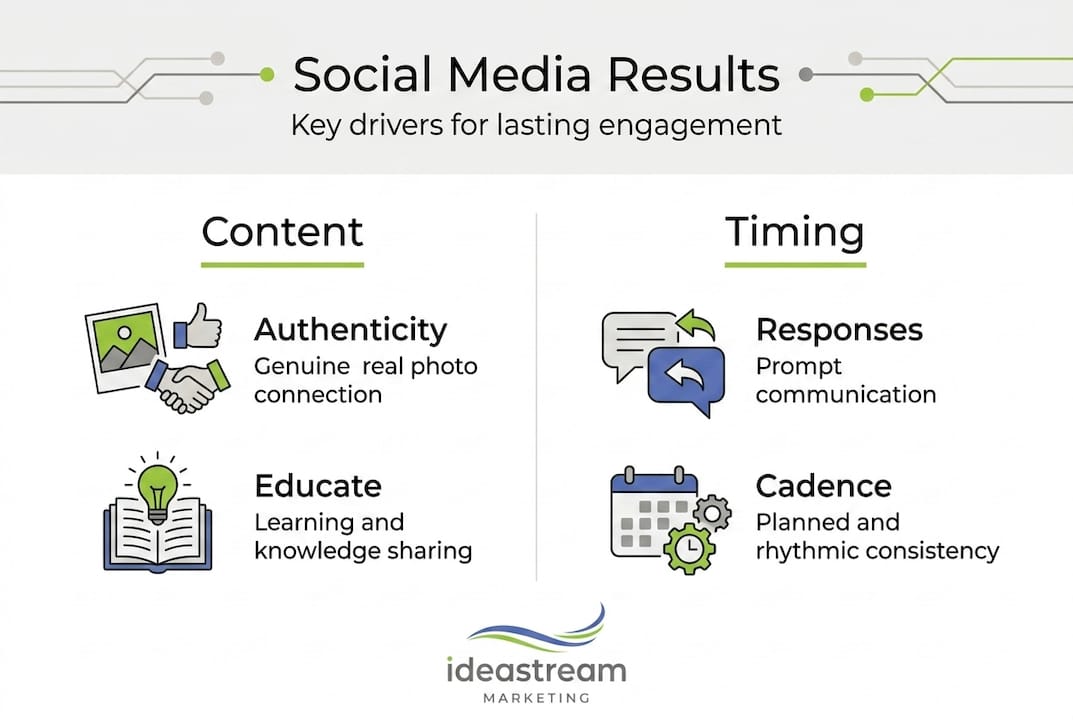
A social media presence without a framework is just noise. The best marketing teams operate from a clear structure that defines what they post, when they post it, and which platforms deserve their attention. Key methodologies include content pillars, consistent posting schedules, platform-specific optimization, and rapid response to engagement.
One of the most practical frameworks is the 40/30/20/10 content rule:
- 40% educational content: Tutorials, how-to posts, and explainer videos that provide clear value to your audience.
- 30% entertaining or storytelling content: Behind-the-scenes footage, team culture posts, and narrative-driven videos that build connection.
- 20% promotional content: Product features, service highlights, case studies, and direct offers.
- 10% curated or user-generated content: Sharing third-party content or featuring customer testimonials and reviews.
This balance prevents your feed from becoming a sales catalog while still moving audiences toward conversion.

Platform selection and posting cadence
Not every platform is worth your time. The decision on where to invest should be driven by your audience demographics and your content format strengths. Here is a comparison of key platform benchmarks to guide your selection:
| Platform | Avg. engagement rate | Best content type | Ideal posting frequency |
|---|---|---|---|
| TikTok | 5.96% | Short-form video | 5-7x per week |
| 1.94% | Reels, carousels | 3-5x per week | |
| 200% B2B ROI | Articles, thought leadership | 3-4x per week | |
| 0.60% | Video, community posts | 3-5x per week | |
| YouTube | Varies | Long and short-form video | 1-2x per week |
TikTok’s 5.96% engagement rate and LinkedIn’s documented 200% ROI for B2B campaigns show that platform choice is not just about audience size. It is about where your content format and audience intent align.
Pro Tip: Resist the urge to post on every platform. Pick your top two based on where your customers already spend time, then execute consistently before expanding. Spreading your team too thin across six platforms produces mediocre results everywhere.
Engagement timing also matters more than most teams realize. Responding to comments and messages within the first 60 minutes after posting signals to platform algorithms that your content is generating active conversation, which increases the likelihood of broader distribution. This is a small habit that compounds over time.
Exploring digital marketing strategies that integrate social media with other channels can amplify your results further. Many of the same audience insights you gather from social can inform your SEO and paid ad targeting. Teams that use AI digital marketing strategies to analyze cross-channel data tend to optimize faster and with greater precision.
Once the framework is defined, you need to understand how to optimize for engagement in a changing algorithmic landscape.
Navigating algorithms and maximizing engagement
Every major platform uses an algorithm to decide which content surfaces and which gets buried. Understanding the basic logic behind these systems does not require an engineering degree. What it requires is a shift in how you measure success. Algorithms prioritize relevance, engagement, and recency, which means organic reach is under increasing pressure and paid amplification has become a necessary complement to organic efforts.
Here is what actually moves the needle with algorithms today:
- Saves and shares carry more algorithmic weight than likes. A post that someone saves to revisit later signals genuine value. Shares signal that the content is worth spreading beyond the original audience.
- Strong CTAs (calls to action) placed early in captions or video scripts prompt the micro-interactions algorithms reward. “Save this for later” or “Share this with your team” are direct and effective.
- Visual quality still matters. Blurry thumbnails and poorly lit videos lose clicks before the algorithm has a chance to assess engagement.
- Hashtag strategy has evolved. Fewer, more targeted hashtags now outperform broad tag-stacking. Stick to 3 to 5 highly relevant hashtags per post rather than 30 generic ones.
Organic reach alone is no longer sufficient for most businesses. Educational content leads audience demand, but without paid amplification, even great content may reach only a fraction of your followers. Budget for boosted posts and targeted paid campaigns as a standard part of your social strategy, not a last resort.
AI ROI data shows that AI-assisted campaign optimization can produce up to 3x the return compared to manually managed campaigns, primarily because AI can process audience signal data faster and adjust targeting in real time.
Tracking the right KPIs (key performance indicators) is equally important. Many teams still report on follower counts and likes, which measure vanity rather than value. Instead, focus on:
- Saves and shares per post
- Click-through rate from social to your website
- Conversion rate from social-driven traffic
- Cost per lead from paid social campaigns
Integrating AI-enhanced marketing tools into your workflow allows you to track these metrics automatically and surface insights that would take hours to compile manually. Reviewing your social media portfolio of past campaigns against these KPIs gives you a realistic picture of what is working and what needs adjustment.
To sustain these practices, you also need to address deeper success factors, including content authenticity and burnout risk.
Balancing authenticity, AI, and team sustainability
AI tools have made content creation faster, but speed without intention creates problems. AI content risks eroding trust if it is not disclosed, and audiences are increasingly sensitive to content that feels automated or generic. The brands that use AI most effectively treat it as a production accelerator, not a replacement for genuine voice and perspective.
Here are the key principles for balancing AI and human content:
- Disclose AI-generated content when it is substantive. Audiences appreciate transparency, and it protects your brand from accusations of deception.
- Use AI for structure, not soul. AI can draft a caption framework or suggest posting times, but the insight, opinion, and brand voice should come from your team.
- Prioritize human content for trust-building posts. Customer testimonials, thought leadership articles, and community engagement posts perform better and build deeper loyalty when they are clearly human.
- Audit your content mix quarterly. If AI-assisted posts are dominating your feed, rebalance toward more human-generated content.
Micro-influencer partnerships offer a powerful alternative to relying entirely on branded content. A niche creator with 25,000 highly engaged followers in your industry can drive more qualified traffic than a celebrity with 2 million passive followers. The engagement is more authentic, the audience trust is higher, and the cost is significantly lower.
“Micro-influencers outperform macro-influencers in niche engagement and ROI not because they are cheaper, but because their audiences chose them for a specific reason. That specificity is the value.”
Team burnout is a real operational risk that is often overlooked in marketing planning. Burnout affects 76% of marketers, and the pressure to post daily across multiple platforms is a major driver. Sustainable posting cadences protect teams and preserve the creative quality that makes content worth engaging with in the first place. Volume without quality is noise.
Practical steps to protect your team:
- Build a content calendar two to four weeks ahead so no one is scrambling to post same-day.
- Batch-create content in dedicated sessions rather than creating on demand.
- Assign clear ownership for each platform rather than expecting everyone to manage everything.
- Set realistic expectations for response times so your team is not tethered to notifications all day.
Investing in tools like digital graphic creation platforms that streamline visual production can reduce the time your team spends on each piece of content without sacrificing quality.
With these best practices and pitfalls in mind, let’s reflect on what truly drives lasting outcomes in social media marketing.
Our perspective: What most marketers miss about social media success
Most marketing teams we work with share a common problem: they have spread themselves too thin. They are active on five or six platforms, posting inconsistently, tracking the wrong metrics, and chasing trends instead of building an audience. The result is a lot of effort with frustratingly little return.
Our perspective is direct. Choose two platforms where your audience actually lives and commit to those completely before expanding. It is far better to be genuinely influential on two platforms than mediocre on six. The businesses that grow fastest on social media are not the ones posting the most. They are the ones posting with purpose, responding with speed, and measuring what actually matters.
Saves and shares are the real signal. A post that gets 300 likes but 50 saves is worth more than a post with 1,000 likes and 5 shares. The save tells you the content delivered genuine value. The share tells you it was worth spreading. Those are the posts to study and replicate.
We also want to be honest about chasing virality. Viral moments are largely unpredictable, and building a strategy around going viral is like building a business plan around winning the lottery. What you can control is consistency, quality, and relevance to your specific audience. When those three things align over time, growth follows. It may not feel as exciting as a viral spike, but it is far more sustainable.
Reviewing smart digital marketing strategies built around long-term audience development rather than short-term spikes is where we recommend most businesses start when rethinking their social approach.
Elevate your social media strategy with our expertise
Knowing what works and executing it consistently are two very different things. Many marketing teams have the knowledge but lack the bandwidth, tools, or specialized expertise to build and manage a high-performance social media strategy from the ground up.
At Idea Stream Marketing, we integrate AI SEO services, strategic search engine optimization, and video marketing services into a cohesive approach that connects your social media presence to measurable business growth. Our team works with businesses across professional services, healthcare, hospitality, and financial services to build systems that generate leads and build brand equity over time. If you are ready to stop guessing and start growing, connect with our team today for a tailored consultation.
Frequently asked questions
What is the average engagement rate for social media marketing?
Average engagement rates range from 1.4% to 2.8% across most platforms, with TikTok showing a notably higher rate of 5.96% due to its algorithm’s strong content distribution model.
Which content type generates the highest ROI in 2026?
Short-form video delivers the highest ROI, with 41% of marketers ranking it as the most effective content format for driving engagement and conversion results.
How often should brands post on TikTok and Instagram?
Posting 3 to 5 times per week on Instagram and up to daily on TikTok gives your content the best chance of consistent algorithmic visibility without exhausting your creative team.
What risks come with using AI-generated content in social media marketing?
Undisclosed AI content risks damaging audience trust over time, which is why transparency about AI use combined with a strong foundation of human-created content is the safer and more effective long-term approach.
How can marketers prevent burnout from constant content creation?
Adopting sustainable posting cadences and batch-creating content in advance protects your team from the chronic pressure of daily production while maintaining consistent quality across your platforms.

