



September 25, 2026




TL;DR:
- Effective social media marketing demands a structured approach with SMART goals, audience research, and content planning, not just consistent posting. Building a system that balances value, engagement, and promotion fosters trust and converts followers into leads, emphasizing ongoing analytics review and platform focus. Success relies on long-term commitment, strategic content mix, and leveraging expert support to sustain growth and maximize ROI.
Most business owners assume that showing up on social media consistently is enough. Post a few times a week, respond to comments occasionally, and the leads will follow. The reality is that structured social media strategy requires far more than activity. It demands SMART goals, audience research, platform selection, content frameworks, and analytics tracking. Without those elements working together, even the most active accounts stall out. This guide walks you through exactly what separates results-driven social media marketing from casual posting, and how to build a system that grows your brand and fills your pipeline.
Table of Contents
- What is social media marketing and why does it matter?
- Building your winning strategy: The proven framework
- Content pillars: Balancing value, engagement, and promotion
- Turning followers into leads: The power of engagement and measurement
- The uncomfortable truth most marketers miss about social media marketing
- Supercharge your social media results with expert support
- Frequently asked questions
Key Takeaways
| Point | Details |
|---|---|
| Strategy beats spontaneity | A structured approach with clear goals and analytics is essential for real business results. |
| Content mix matters | Balancing educational, engaging, and promotional content drives lasting engagement and trust. |
| Engagement fuels growth | Active responses and consistent posting are key drivers of new leads and higher ROI. |
| Measurement guides success | Using analytics allows you to refine your approach and maximize marketing impact. |
What is social media marketing and why does it matter?
Now that we’ve outlined the need for real strategy, let’s break down what social media marketing really means and how it moves the needle for businesses.
Social media marketing is not simply maintaining a presence online. It is a deliberate, goal-oriented practice of using social platforms to reach specific audiences, build brand authority, and generate measurable business outcomes. The difference between a business that posts and a business that markets on social media is the difference between hoping and planning.
“Social media marketing done right is one of the most cost-efficient ways to build brand awareness, generate leads, and nurture relationships with your audience at scale.”
Here is what professional social media strategies actually accomplish for businesses:
- Brand awareness: Consistent, strategic content keeps your brand visible to your target audience, even when they are not actively searching for you.
- Lead generation: Targeted content and calls to action guide followers toward taking the next step, whether that is booking a call, downloading a resource, or visiting your website.
- Audience relationships: Regular, valuable interaction builds trust over time, which is the foundation of long-term customer loyalty.
- Measurable ROI: Unlike traditional advertising, social media provides data on reach, engagement, clicks, and conversions so you can see exactly what is working.
- Cost-efficient reach: Organic social content and even paid social ads offer a lower cost per impression compared to many traditional media channels.
The core mechanics of social media marketing involve creating a structured strategy with SMART goals and active engagement. Being active is not the same as being strategic. Structure and purpose are what turn a social media account into a genuine business asset.
Building your winning strategy: The proven framework
With a clear understanding of what makes social media marketing distinct, it is time to dive into a step-by-step process for building a strategy that drives real results.
A winning social media strategy is built in layers. Each layer supports the next, and skipping one creates gaps that undermine your results. The core mechanics of strategy include SMART goals, audience research, platform selection, and content pillars working together as a system.
Here is the proven framework we recommend for businesses ready to get serious:
- Set SMART goals. Every strategy starts with clarity. SMART stands for Specific, Measurable, Achievable, Relevant, and Time-bound. Instead of “grow our Instagram,” a SMART goal sounds like “increase Instagram followers by 20% in 90 days by posting 4 times per week and running two engagement campaigns.” This specificity drives every decision that follows.
- Research your audience. Who are you trying to reach? What problems do they have? Where do they spend time online? What content formats do they prefer? Audience research shapes everything from your tone of voice to the platforms you prioritize. Use existing customer data, social analytics, and competitor research to build a clear picture of your ideal follower.
- Choose the right platforms. Not every platform fits every business. LinkedIn works well for B2B professional services. Instagram and TikTok perform strongly for visually driven brands and consumer products. Facebook remains effective for local service businesses and community-focused brands. Pinterest drives traffic for lifestyle, home, and food-related businesses. Pick two or three platforms where your audience already lives rather than spreading yourself thin across all of them.
- Define your content pillars. Content pillars are the three to five core themes your brand consistently talks about. For a law firm, pillars might include legal tips, client success stories, team culture, and community involvement. Pillars keep your content focused and make planning far easier.
- Build a content calendar with batching. Batching means creating multiple pieces of content in one sitting rather than scrambling daily. Plan your content one to two weeks ahead, assign themed days (for example, Tip Tuesday or Behind-the-Scenes Friday), and schedule posts in advance using a tool like Buffer or Later.
Pro Tip: Batch your content creation on one day each week. Spend two to three hours creating and scheduling all posts for the following week. This single habit eliminates daily scrambling and keeps your strategy consistent even during busy periods.
| Strategy element | Why it matters | Recommended action |
|---|---|---|
| SMART goals | Provides direction and accountability | Set one primary goal per quarter |
| Audience research | Shapes content, tone, and platform choice | Review audience analytics monthly |
| Platform selection | Focuses effort where your audience already is | Start with 2 platforms maximum |
| Content pillars | Keeps messaging consistent and purposeful | Define 3 to 5 core themes |
| Content calendar | Prevents gaps and reduces daily stress | Plan 2 weeks ahead with batching |
| Posting consistency | Builds algorithmic reach and audience trust | Post 3 to 5 times per week |
Applying smart digital marketing strategies at this planning stage is what separates businesses that see steady growth from those that plateau. It also helps you maximize content reach by repurposing one strong piece of content across multiple platforms without starting from scratch each time.
Content pillars: Balancing value, engagement, and promotion
Now that your plan is in place, let us look at optimizing what you post, because content mix is what keeps your audience coming back.

One of the most common mistakes businesses make is posting too much promotional content. If every post is about your product, service, or offer, your audience tunes out quickly. The most effective social media accounts follow proven content frameworks that prioritize value over self-promotion.
Industry frameworks suggest content pillars such as 80/20 educational/promotional and 70/20/10 value/share/promote for maximizing impact. Here is how both models break down in practice:
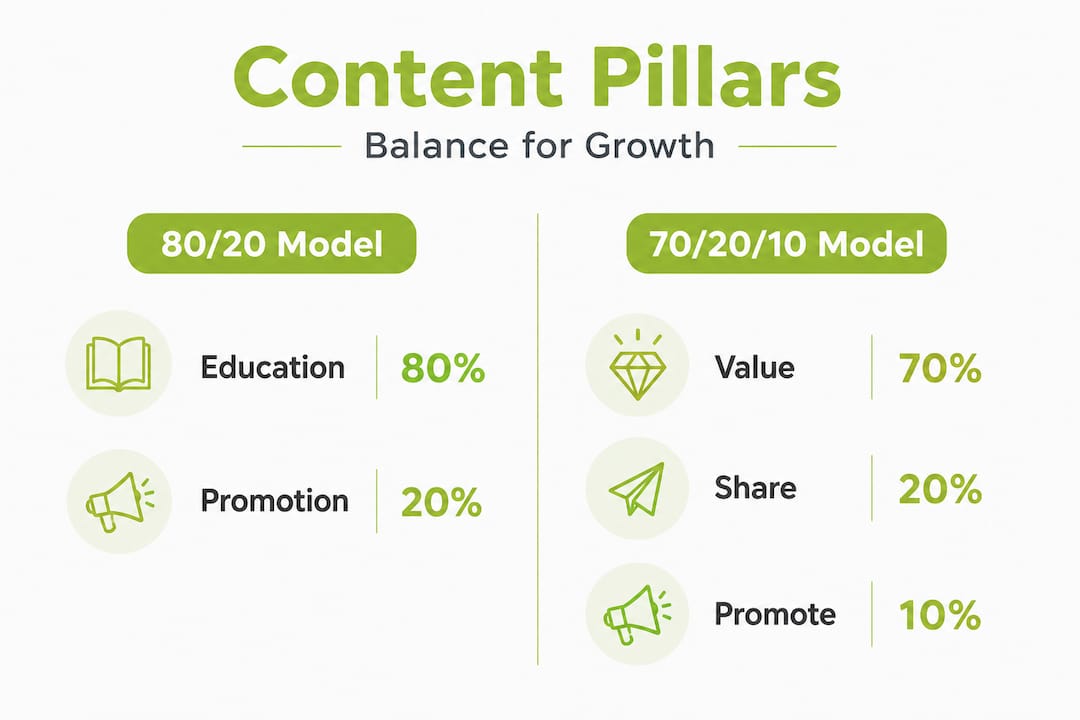
| Framework | Educational/Value | Shared/Engaging | Promotional |
|---|---|---|---|
| 80/20 model | 80% of posts | N/A | 20% of posts |
| 70/20/10 model | 70% of posts | 20% of posts | 10% of posts |
The 80/20 model is simpler to execute. Four out of every five posts teach, entertain, or inspire. One post promotes your offer. The 70/20/10 model adds a middle layer of shared content, such as industry news, partner spotlights, or user-generated content, which builds community and signals credibility.
Here is how to apply these ratios to your calendar:
- Educational posts: How-to guides, tips, myth-busting content, FAQs, and explainer videos. These build trust and establish your brand as an authority.
- Entertaining or relatable posts: Behind-the-scenes content, team highlights, humor relevant to your industry, and storytelling. These humanize your brand.
- Engagement-driven posts: Polls, questions, challenges, and interactive content that invite your audience to respond. These boost algorithmic reach and deepen relationships.
- Promotional posts: Offers, service announcements, case studies, and testimonials. These convert attention into action.
Pro Tip: Use interactive content ideas like polls and question stickers in Stories to drive quick engagement without requiring heavy content production. Even a simple “Which do you prefer?” question can generate dozens of responses and boost your visibility in the algorithm.
Themed days make this easier to execute. Assign a content type to each day of the week. For example: Monday motivation, Wednesday tips, Friday client spotlight. This structure removes the guesswork and keeps your social media management workflow running smoothly week after week.
The non-promotional content is not filler. It is the foundation of trust. Audiences buy from brands they feel connected to, and that connection is built through consistent value delivery long before a promotional post ever appears.
Turning followers into leads: The power of engagement and measurement
Crafting great content is only the beginning. The next step is transforming engagement into real business growth.
Content gets attention. Engagement builds relationships. Measurement turns both into a repeatable system for lead generation. These three elements work together, and neglecting any one of them limits your results.
Consistent posting at 3 to 5 times per week, combined with active engagement and analytics tracking, is what drives measurable ROI from social media. Here is how to put that into practice:
- Respond to every comment and DM within 24 hours. Social media algorithms reward accounts that generate conversation. When you respond quickly and genuinely, you signal to the platform that your content is worth showing to more people. More importantly, you show your audience that a real person is behind the brand.
- Engage with your audience’s content too. Leave thoughtful comments on posts from followers, partners, and prospects. This keeps your brand visible beyond your own feed and builds goodwill that often leads to reciprocal engagement.
- Use calls to action in every post. Not every post needs to sell something, but every post should invite some kind of action. Ask a question, encourage a share, or direct followers to a link in your bio. Clear next steps move people through your funnel.
- Track the metrics that matter. Vanity metrics like follower count tell you very little. Focus on engagement rate, reach, click-through rate, and leads generated. These numbers tell you whether your content is actually resonating and driving business outcomes.
“Data is not the enemy of creativity. It is the compass that keeps your creative efforts pointed toward real business results.”
Pro Tip: Review your analytics every two weeks, not just monthly. Two-week check-ins let you spot trends early and adjust your content mix before a full month of underperforming posts drains your momentum. Look at which content types generate the most saves and shares, because those are the posts your audience finds most valuable.
The power of social media ads becomes especially clear when you layer paid promotion on top of organic content that is already performing well. Boosting a post that has already earned strong organic engagement amplifies what is working rather than gambling on untested creative. Pairing strong written content with social media video content is one of the most effective ways to increase reach and drive qualified leads because video consistently outperforms static images in both reach and engagement across most platforms.
The uncomfortable truth most marketers miss about social media marketing
Here is something we see repeatedly with businesses that come to us after months of frustration: they have been doing a lot of the right things, just not consistently or strategically enough to see results.
The most common failure mode is not ignorance. It is distraction. Business owners chase the newest platform, copy a viral trend that has nothing to do with their brand, or pivot their entire strategy because one post underperformed. This is what we call shiny object syndrome, and it is the single biggest killer of social media momentum.
Sustainable growth on social media comes from the opposite of chasing trends. It comes from showing up consistently, delivering genuine value, and making small, data-informed improvements over time. The businesses we see win on social media are rarely the ones with the flashiest content. They are the ones who post every week without fail, respond to every comment, and review their analytics regularly to understand what their audience actually wants.
There is also a trap called analysis paralysis. Some marketing managers spend so much time studying data and waiting for the perfect strategy that they never actually execute. The truth is that a good strategy executed consistently beats a perfect strategy executed sporadically every single time.
Our honest advice: pick your two platforms, define your content pillars, commit to posting four times per week for 90 days, and measure your results at the end. That single 90-day commitment will teach you more about your audience than any amount of research done in isolation. Applying strategic marketing tips within a focused, consistent system is what separates brands that grow from brands that stall.
Social media is not a shortcut. It is a long game. But when you play it with structure, patience, and genuine commitment to your audience, the compounding results are real and lasting.
Supercharge your social media results with expert support
For those ready to put these strategies to work or elevate their ROI even further, outside expertise can deliver faster, more scalable results.
At Idea Stream Marketing, we build social media systems that do more than fill a content calendar. We create strategies rooted in your business goals, your audience, and your competitive landscape so every post has a purpose and every campaign moves the needle.
Our social media marketing services include full strategy development, content creation, scheduling, engagement management, and performance reporting. Whether you need a complete done-for-you solution or expert guidance to sharpen your existing approach, we have the tools and the team to help. Explore our proven social media strategies and see how we approach growth for businesses like yours. Our social media management solutions are designed to save you time while delivering the consistent, strategic presence your brand needs to stand out. Schedule a consultation today and let’s build something that grows.
Frequently asked questions
How often should I post on social media for my business?
Consistent posting 3 to 5 times per week is the proven standard for most businesses, balancing algorithmic reach with sustainable content production. Prioritize quality and regularity over volume.
What’s the difference between social media marketing and just posting updates?
Social media marketing uses a structured strategy with SMART goals, audience targeting, and performance measurement, while casual posting lacks defined objectives or a system for tracking results.
Which social media platform is best for lead generation?
The best platform is wherever your target audience already spends their time. Platform selection should always be driven by audience research and demographic data rather than personal preference or trend-following.
How do I measure ROI from my social media marketing efforts?
Focus on analytics like engagement, click-through rates, and leads generated rather than follower counts, which give you a clear picture of what content is actually driving business outcomes.
Recommended
- Social media strategies that drive real marketing results | Web Design & Marketing Agency
- Social Media Marketing Agency Long Island NYC
- What is digital marketing? Strategies for scalable growth | Web Design & Marketing Agency
- Long Island Social Synergy Expert Management for Enhanced
- Boost Engagement: Smart Social Media & Website Design