



October 7, 2026




Lead follow-up automation replaces manual, delay-prone outreach with instant acknowledgments and scheduled multi-channel sequences that reach prospects while they’re still paying attention. The core outcome is speed: leads contacted within five minutes convert at far higher rates than those left waiting hours, and the systems that make this possible are simple enough for most sales teams to build in a few weeks. This guide breaks down the components, the setup steps, and the ROI math you need to justify the project.
TL;DR:
- Responding within five minutes significantly boosts lead qualification and conversion rates, as interest declines rapidly after form submission.
- A comprehensive automation stack must include centralized CRM, intelligent routing, multi-channel cadences, and detailed analytics to prevent bottlenecks.
- Building an effective system involves auditing current metrics, creating routing rules, designing personalized multi-channel sequences, and testing before full deployment.
- ROI estimates rely on increasing conversions by responding faster, with payback often within months, especially when response times drop to under five minutes.
- Outsourcing to specialists like Idea Stream Marketing can streamline setup and enhance results through professional content, integrated workflows, and measurement-focused strategies.
Table of Contents
- Why Automated Lead Response Matters More Than Most Sales Teams Realize
- Core Components Every Working Follow-Up System Needs
- How Do You Build an Automated Lead Follow-Up System?
- What ROI Should You Expect From Lead Follow-Up Automation?
- How Idea Stream Marketing Approaches Lead Follow-Up Automation
- Should You Build This In-House or Hire Help?
- Idea Stream Marketing: How We Help and What Comes Next
- Sources
- FAQ
Why Automated Lead Response Matters More Than Most Sales Teams Realize
Speed to lead isn’t a nice-to-have metric buried in a dashboard. It’s the difference between closing a deal and never speaking to the prospect again. Responding within five minutes rather than 30 can increase close rates dramatically, because interest decays fast once someone submits a form or fills out a contact request. Most businesses simply aren’t built to respond that fast without help, and the gap shows up directly in lost revenue.
Automated lead nurturing solves a related problem: consistency. A rep having a busy Tuesday shouldn’t determine whether a lead gets a same-day reply. Automation removes that variance entirely.
The measurable benefits break down into a few categories:
- Captured intent — instant acknowledgment keeps the prospect engaged before they move to a competitor.
- Consistency at scale — every lead gets the same cadence regardless of headcount or time of day.
- Lower cost per lead — fewer leads go cold, so paid campaigns generate more customers per dollar spent.
Speed-to-lead statistic: Responding within the first five minutes is repeatedly cited as one of the strongest predictors of lead qualification and conversion across sales research, compared with responses that arrive hours or days later.
Core Components Every Working Follow-Up System Needs
An effective automated lead response setup isn’t one tool. It’s a stack of connected pieces, each solving a specific failure point in the traditional sales funnel.
- Centralized lead capture and CRM as the source of truth. Every form, chat widget, phone call, and ad click needs to land in one place. A CRM built for automation keeps lead data consistent instead of scattered across spreadsheets and inboxes.
- Enrichment and dedupe. Automatically append company size, location, and source data, and merge duplicate entries before they confuse routing rules.
- Smart routing and ownership. Leads should reach the right rep or team automatically, based on territory, product interest, or deal size, with no manual sorting.
- Immediate acknowledgment and a multi-channel cadence engine. This is the heart of the system: automated lead nurturing across email, SMS, and voice, timed to hit prospects while intent is still fresh.
- Integrations and connectors. Webhooks, automation platforms like Zapier or Make, and messaging APIs tie your forms, phone system, and CRM together.
- Analytics and event tracking. Every touch, open, click, and reply needs to be logged so you can measure what’s actually working.
Skipping any one of these creates a bottleneck. Routing without enrichment sends leads to the wrong rep. Cadences without analytics leave you guessing which touch actually converted.
How Do You Build an Automated Lead Follow-Up System?
Building this out doesn’t require a massive IT project. It requires a defined sequence, executed in order, with testing built in before full rollout.
- Audit your baseline first. Pull three numbers from your CRM: median time to first human contact, the percentage of leads with zero contact within 24 hours, and your current lead-to-customer conversion rate by contact speed. You can’t measure improvement without a starting point.
- Centralize every lead source into one CRM or lead queue. Preserve UTM parameters and metadata on the way in, so you know which channel and campaign generated each lead.
- Build routing rules and ownership logic. Define escalation paths: what happens if a rep doesn’t respond within 15 minutes, and who picks up the lead next.
- Design the immediate acknowledgment plus a 7-touch multi-channel cadence. Mix email, SMS, and a scheduled call attempt across the first 10 days, with the first touch landing in the initial five minutes and later touches spaced to avoid overwhelming the prospect.
- Configure notifications and human handoff triggers. Hot leads, like a pricing page visit followed by a form fill, should alert a live rep immediately rather than sitting in the automated queue.
- Test for two weeks before declaring success. Send end-to-end test inquiries through every form and channel, track actual response times against your baseline, and adjust cadence timing based on real reply data.
Pro Tip: Set your first automated touch to fire in under five minutes, but make it feel personal. A short, name-personalized text or email that references the specific form they filled out will outperform a generic “thanks for reaching out” every time.
A step-by-step lead generation framework can help structure this rollout if your team is building the sequence for the first time.
What ROI Should You Expect From Lead Follow-Up Automation?
The ROI math is straightforward once you have your baseline numbers. Multiply monthly lead volume by your current conversion rate to get baseline customers, then apply a conservative lift percentage based on faster response, typically pulled from the studies showing five-minute response windows outperforming same-day follow-up. The additional customers generated, multiplied by average customer value, gives you projected new revenue. Subtract your tooling cost, and you have net monthly return.
| Input | What to pull | Typical range |
|---|---|---|
| Monthly lead volume | CRM report | Varies by business |
| Baseline conversion rate | CRM, by contact speed | Business-specific |
| Tooling cost | Automation platform + SMS/voice fees | $100–$400/month |
| Payback timeline | Revenue lift vs. tooling cost | Often within months |
A/B test cadence length, first-touch channel, and message tone, then report response time, conversion lift, and cost per acquisition to stakeholders every month.
How Idea Stream Marketing Approaches Lead Follow-Up Automation
Most failed automation builds share the same root causes: routing rules that send leads to the wrong owner, lost UTM attribution that makes it impossible to tell which channel actually worked, and cadences built around CRM stages that don’t match how the sales team actually sells.
Idea Stream Marketing addresses these gaps directly, and one advantage worth highlighting: dropping short-form video or podcast clips into a follow-up sequence measurably increases reply rates by giving the prospect quick social proof instead of another wall of text.
- Pre-launch checklist covering routing logic, attribution tracking, and CRM stage alignment before a single sequence goes live.
- Testimonial or explainer video clips embedded directly in email and SMS touches.
- Repurposed podcast episode clips used as a personal, low-effort touch in later-stage cadences.
- Measurement points tied to response time and conversion lift, not just open rates.
Should You Build This In-House or Hire Help?
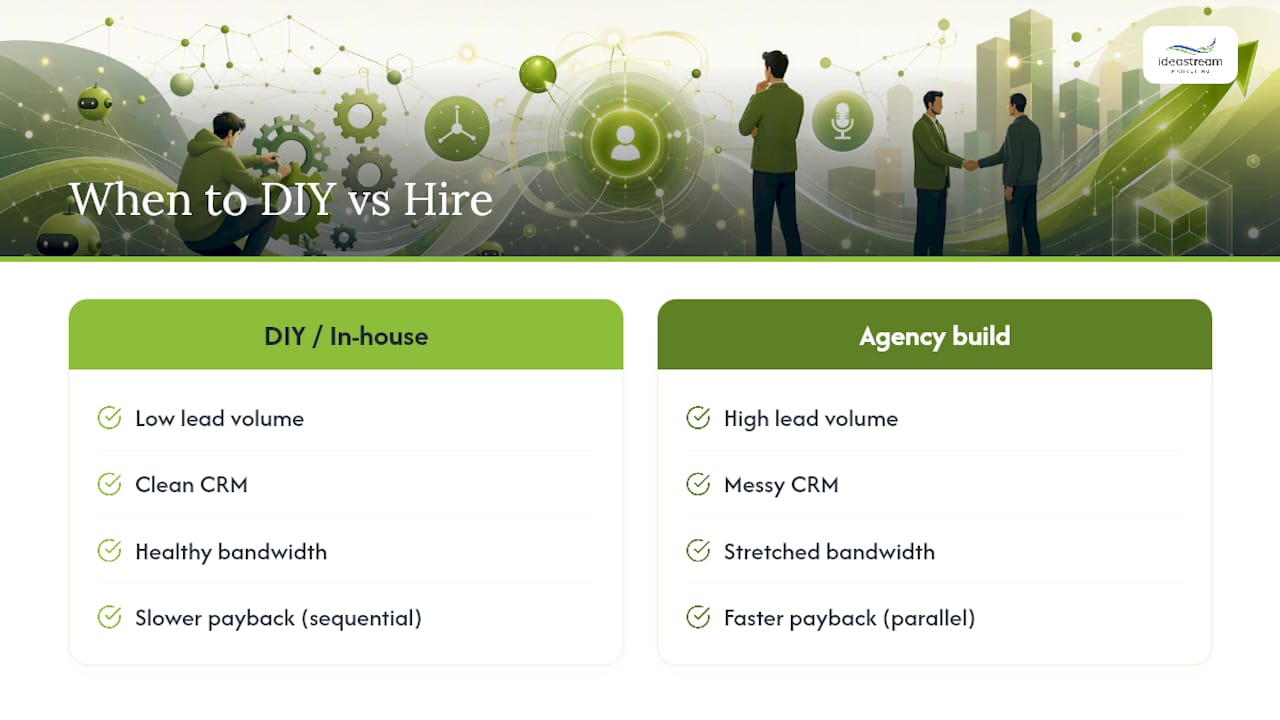
The decision usually comes down to three factors: lead volume, internal bandwidth, and how clean your CRM already is. Low volume with a healthy CRM often justifies a DIY build over a few weeks. High volume, messy data, or a stretched team usually means an agency build pays back faster, particularly when automated workflows and content production run in parallel rather than sequentially.
Idea Stream Marketing: How We Help and What Comes Next
Idea Stream Marketing is the alternative to hiring a generalist agency or piecing together disconnected tools for lead follow-up automation. We build the CRM routing, the cadence logic, and the video and podcast assets that go inside those sequences, all under one roof, so you’re not managing three vendors to launch one system.
Our approach pairs CRM automation setup with in-house video production and podcast production, so the follow-up clips your prospects receive are produced professionally instead of shot on a phone. Success gets measured the same way we describe above: baseline response time versus post-launch response time, conversion lift, and cost per acquisition, tracked monthly.
If your current follow-up process depends on a rep remembering to send an email, it’s time for a Marketing Systems Diagnosis. Schedule a consultation with Idea Stream Marketing to map your routing rules, cadence, and content plan before you build anything.
Sources
FAQ
What is the best way to follow up with leads?
The best approach combines an immediate automated acknowledgment with a multi-touch cadence across email, SMS, and phone, spaced over the first 7 to 10 days after the lead comes in.
What is a lead automation system?
A lead automation system centralizes incoming leads into one CRM, routes them to the right owner, and triggers scheduled multi-channel follow-up sequences without requiring manual outreach for every touch.
What does lead automation mean?
It means using software to handle the repetitive parts of sales follow-up, like acknowledgment messages, scheduling, and reminders, so reps spend their time on conversations that actually need a human.
How do I follow up on a lead?
Acknowledge the lead within minutes, then follow a structured cadence that mixes channels, referencing what they specifically inquired about rather than sending a generic message.
How much does lead follow-up automation cost to set up?
Costs vary by business and tooling choice; current pricing for Idea Stream Marketing’s automation and CRM setup services is available by requesting a consultation on our site.