



October 16, 2026




TL;DR:
- Digital marketing uses online channels to attract and convert customers at scale. It offers global reach, real-time data, and cost-effective scalability to outperform traditional methods. Integrating AI and aligning marketing with business goals enhances performance and long-term growth.
Digital marketing is the strategic use of online channels, including search engines, social media, email, and paid advertising, to attract, engage, and convert customers at scale. Understanding why digital marketing matters is no longer optional for business owners. It is the primary driver of customer acquisition, brand visibility, and measurable revenue growth in 2026. Platforms like Google Ads and Facebook Ads, tools like Salesforce, and services like Leadpages have made it possible for businesses of any size to compete on a level field, reach global audiences, and track every dollar spent.
Why digital marketing matters: core business benefits
Digital marketing offers 15 distinct advantages over traditional promotion, with global reach, real-time tracking, and precise audience targeting leading the list. That breadth of capability means you can run a campaign in the morning, review performance by noon, and reallocate budget to the best-performing channel before the end of the day.
Here is what those advantages look like in practice:
- Global reach without proportional cost. A local Long Island law firm can run a Google Ads campaign that reaches prospects across New York State without printing a single brochure.
- Precise audience targeting. Facebook Ads lets you target by age, income, job title, and behavior. You stop paying to reach people who will never buy from you.
- Real-time performance data. You can monitor impressions, clicks, conversions, and customer lifetime value daily. Budget decisions become facts, not guesses.
- Cost-effective scalability. Start with a $500 monthly budget, prove results, then scale. Traditional TV or print does not offer that flexibility.
- Customer loyalty through personalization. Personalized content and email build two-way relationships that drive long-term retention and advocacy.
The last point deserves emphasis. Most business owners think of marketing as broadcasting. Digital marketing is a conversation. When a customer clicks your email, visits your site, and then sees a retargeted ad on Instagram, that sequence builds familiarity and trust in a way a billboard never can.
Pro Tip: Set up Google Analytics 4 and connect it to your Google Ads account from day one. The combined data gives you a full picture of which channels drive revenue, not just traffic.

Digital marketing vs. traditional marketing: key differences
The clearest way to understand the importance of digital marketing is to compare it directly with traditional methods. The differences are not subtle.
| Factor | Digital Marketing | Traditional Marketing |
|---|---|---|
| Cost to start | Low; budgets as small as $5/day | High; print ads can cost thousands per run |
| Audience targeting | Demographic, behavioral, geographic | Broad, limited segmentation |
| Performance tracking | Real-time, measurable KPIs | Estimated reach, no direct attribution |
| Flexibility | Adjust campaigns instantly | Changes require new production cycles |
| Scalability | Scale up or down based on results | Fixed costs regardless of performance |
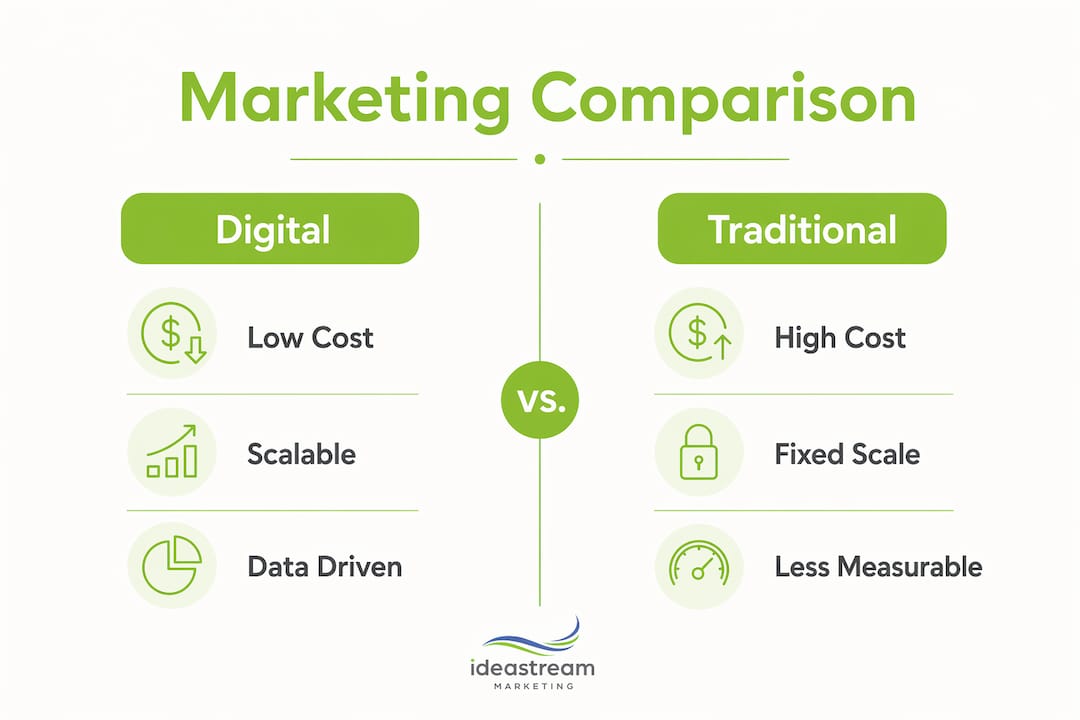
Small businesses can start small with controlled budgets and scale only when results prove effective. A single print ad may cost thousands for a single day of exposure. That same budget in Google Ads or Facebook Ads can run for weeks, generate trackable leads, and be paused the moment results dip.
Digital channels also level the playing field. A regional healthcare provider or a home services company in Nassau County can appear alongside national brands in Google search results. The quality of your SEO strategy and ad targeting matters more than the size of your marketing budget.
Pro Tip: If you are moving budget from print or direct mail to digital, start by running both in parallel for 60 days. The data comparison will make the ROI case for you without any guesswork.
How does AI change why digital marketing matters today?
AI has transformed digital marketing from a promotional function into the backbone of business operations. Automation, personalization, and predictive analytics are now central to every high-performing campaign. Businesses that fail to integrate AI risk losing search visibility to competitors whose campaigns are already optimized by machine learning.
The practical impact of AI on digital marketing includes:
- Predictive audience targeting. AI tools analyze past behavior to predict which prospects are most likely to convert, so your ad spend goes to the right people.
- Content personalization at scale. AI-driven email platforms, like those used in AI-powered email marketing, can send different messages to different segments automatically based on user behavior.
- SEO aligned with AI algorithms. SEO focused on content quality and AI-algorithm alignment drives organic traffic with higher conversion rates than paid ads alone. Search engines like Google now use AI to evaluate content relevance, which means your SEO strategy must account for how AI reads and ranks pages.
- Campaign optimization in real time. AI tools adjust bids, rotate ad creative, and shift budget between channels without manual intervention, reducing wasted spend.
- Chatbot and automation integration. AI chatbots on your website capture leads 24/7, qualify them, and route them to your sales team with full context.
Understanding how AI transforms digital marketing is no longer a technical curiosity. It is a competitive requirement. The businesses winning in search and social right now are the ones that have built AI into their marketing systems, not bolted it on as an afterthought.
How can businesses implement digital marketing effectively?
Knowing the benefits of online marketing is one thing. Building a system that delivers them consistently is another. Here is a practical framework for business owners and managers who want to move from awareness to execution.
- Align digital marketing with your business goals. Define what success looks like before choosing a channel. A law firm focused on personal injury cases needs local SEO and Google Ads. A restaurant needs social media and Google Business Profile optimization. The channel follows the goal.
- Select channels based on your audience and budget. Not every business needs to be on every platform. Start with two or three channels where your customers already spend time. For most B2B companies, that means Google Search and LinkedIn. For B2C, it often means Google, Instagram, and Facebook.
- Track the right KPIs from day one. Vanity metrics like page views tell you very little. Focus on cost per lead, conversion rate, customer acquisition cost, and return on ad spend. These numbers connect marketing activity directly to revenue.
- Break down the silos between marketing, sales, and service. Marketing data flowing into sales and service teams ensures leads are nurtured with context, which improves conversion rates. Salesforce research confirms that online marketing should not operate in isolation. It must be part of a unified customer experience.
- Treat digital marketing as an ongoing function, not a one-time project. Integrating digital marketing as a core business function unlocks the flexibility to pivot rapidly and increases overall efficiency. Campaigns need regular review, testing, and adjustment to stay effective.
For small businesses specifically, the path to competing with larger players runs directly through smart digital marketing strategies that prioritize data over assumptions. You do not need a massive budget. You need a clear strategy, the right channels, and consistent measurement.
Key takeaways
Digital marketing delivers measurable growth, customer engagement, and competitive advantage that traditional marketing cannot replicate at the same cost or scale.
| Point | Details |
|---|---|
| Real-time measurement | Track clicks, conversions, and ROI daily to reallocate budget to top-performing channels. |
| AI is now central | Businesses without AI integration in their marketing systems lose visibility to AI-optimized competitors. |
| Digital beats traditional on cost | Digital campaigns start at low daily budgets and scale based on proven results, unlike fixed-cost print or TV. |
| Break down marketing silos | Connecting marketing data to sales and service teams improves lead quality and conversion rates. |
| Strategy before channel | Define your business goal first, then select the digital channel that serves that goal most directly. |
The risk of treating digital marketing as optional
I have worked with business owners across Long Island, New York City, and nationwide who delayed their digital marketing investment because their referral pipeline felt strong enough. Almost every one of them eventually faced the same moment: a competitor with a sharper digital presence started taking market share, and the referral pipeline dried up faster than expected.
The shift in consumer behavior is not gradual anymore. People search before they call. They check reviews before they visit. They compare your website to your competitor’s in about eight seconds. If your digital presence does not communicate trust and relevance immediately, you lose that prospect before the conversation even starts.
What I find most telling is how many businesses still treat digital marketing as a department rather than a system. The companies that grow consistently are the ones that have connected their marketing data to their sales process and their customer service. That integration is where the real efficiency lives. It is not about running more ads. It is about building a machine where every touchpoint feeds the next one.
The digital marketing significance in 2026 is not about keeping up with trends. It is about building a business that can be found, trusted, and chosen by the right customers at the right moment. That is a structural advantage, and it compounds over time.
— Dean
How Idea Stream Marketing helps you build that advantage
If this article clarified the role of digital marketing in your business growth, the next step is building a system that actually delivers results. Idea Stream Marketing works with businesses across Long Island, New York City, and the United States to design and execute data-driven digital marketing strategies that connect marketing, sales, and customer engagement into one measurable system.
From AI SEO services that improve your organic search rankings to Google Ads management, social media campaigns, and AI-powered lead generation, we build programs around your specific business goals. Whether you are a law firm, healthcare provider, restaurant, or growth-focused company, we create strategies that generate real leads and real revenue. Schedule a consultation with our team and let us show you exactly where your digital presence stands today and what it takes to grow it.
FAQ
What is digital marketing in simple terms?
Digital marketing is the use of online channels such as search engines, social media, email, and paid ads to attract and convert customers. It gives businesses measurable control over how they reach and engage their audience.
Why do small businesses need digital marketing?
Small businesses need digital marketing because it lets them compete with larger brands at a fraction of the cost. Digital channels like Google Ads and Facebook Ads allow precise targeting and real-time budget control that traditional advertising cannot match.
How does AI affect digital marketing results?
AI improves digital marketing by automating targeting, personalizing content at scale, and optimizing campaigns in real time. Businesses that integrate AI into their marketing systems consistently outperform those relying on manual campaign management.
What is the biggest mistake businesses make with digital marketing?
The biggest mistake is running marketing in a silo, separate from sales and service data. Connecting those data flows, as Salesforce research confirms, dramatically improves lead quality and conversion efficiency.
How do you measure the impact of digital marketing?
Measure digital marketing impact through cost per lead, conversion rate, customer acquisition cost, and return on ad spend. These KPIs connect marketing activity directly to revenue rather than relying on estimated reach or impressions.

