



September 25, 2026




The fastest way to make customer testimonial videos that drive trust and conversions is to ask your best customer a specific question about a measurable result, film their answer on camera, and place that video directly on the page where buyers make their decision.
That’s the whole playbook in one sentence. Everything below is how to execute it well.
Your three-step starting point:
- Who to ask: Pick a customer who achieved a clear, quantifiable result with your product or service and who communicates naturally on camera.
- What to film: Capture their answer to one focused question: “What changed for your business after working with us?” Then build the surrounding story around that answer.
- Where to place it: Put the video on your highest-traffic conversion page, whether that’s a product page, a landing page, or a proposal deck, before you place it anywhere else.
Highest-leverage priority: Get the video on a conversion page first. A/B test that placement before you spend time distributing it across social channels. Conversion-page placement consistently delivers the fastest, most measurable return.
Table of Contents
- Why do customer testimonial videos persuade buyers?
- Annotated examples you can copy from each format
- How do you collect testimonial videos from customers?
- DIY, hybrid, or full pro: which production path fits your situation?
- How to edit interviews into persuasive, platform-ready testimonial videos
- Where should you publish testimonial videos and what should you measure?
- What does a testimonial video actually cost, and how long does it take?
- Your production checklist and interview question templates
- How Idea Stream Marketing produces testimonial videos
- Key Takeaways
- What most people get wrong about testimonial videos
- Ideastreammarketing can handle your testimonial video production end to end
- Further reading and authoritative sources
- FAQ
Why do customer testimonial videos persuade buyers?
The short answer is that video activates three psychological levers that written reviews cannot: social proof, vividness, and source credibility. When a real person looks into a camera and describes a specific result, the viewer’s brain processes it as a peer recommendation, not an advertisement.
MNTN Research documents that testimonial videos are among the most trusted ad formats available to marketers, with buyers consistently rating peer video content above brand-produced promotional content. That preference gap is widest at the consideration and decision stages of the funnel, exactly where most sales are won or lost.
Video also holds attention in a way that text simply cannot compete with. Statista’s data on online video consumption shows that average daily time spent watching online video continues to grow year over year, which means your audience is already conditioned to receive information through video. Placing a testimonial in that format meets them where they already are.
For B2B marketers specifically, Content Marketing Institute’s B2B research confirms that customer stories rank among the most effective content assets for moving buyers through a long sales cycle. A video testimonial compresses what might otherwise take three sales calls into a two-minute watch.
The ROI case is concrete. VideoTestimonials.video’s data documents A/B tests showing conversion lifts of 20–80% when testimonial videos are added to landing pages. One asset, placed correctly, can pay for its production cost within weeks.
Annotated examples you can copy from each format
Studying what works in real testimonial videos is faster than theorizing. The Customer Testimonial Videos YouTube playlist is a practical reference for format and pacing. Here are four formats worth studying, with the single element to steal from each.
Short social clip (15–30 seconds)
The best short-form testimonials open with the result, not the backstory. A healthcare software company’s 20-second clip that opens with “We cut patient intake time in half” and closes on the speaker’s name and title is a textbook example. The hook is the metric. Copy this: write the result on screen in the first three seconds, then let the speaker confirm it in their own words.
Best for: awareness stage, paid social, retargeting.
Full B2B case-study testimonial (90–120 seconds)
A manufacturing client describing a supply chain problem, the evaluation process, and a specific cost reduction follows the five-part structure almost perfectly. The edit cuts between the speaker and B-roll of the actual facility, which grounds the story in physical reality. Copy this: shoot at least 60 seconds of B-roll on location. It transforms a talking-head video into a credible case study.
Best for: consideration and decision stages, proposal decks, sales follow-up emails.
UGC-style product review (30–60 seconds)
Shot on a phone, natural lighting, slightly imperfect audio. The speaker is clearly not reading from a script. This format works precisely because it looks like something a friend sent you, not something a marketing team produced. Copy this: give customers a one-question prompt and let them record on their own device. The rawness is the feature.
Best for: product pages, e-commerce, consumer brands at the consideration stage.
On-site interview (60–90 seconds)
Filmed at the customer’s location, with their team visible in the background. The environment does the credibility work before the speaker says a word. A law firm testimonial shot in a conference room with branded materials visible in the background signals legitimacy immediately. Copy this: always ask if you can film at the customer’s location rather than a neutral studio. The setting tells its own story.
Best for: professional services, B2B, decision-stage buyers who need to see proof of scale.
How do you collect testimonial videos from customers?
Timing is the most underrated variable in testimonial collection. The best moment to ask is immediately after a customer experiences a clear win, not at contract renewal when the relationship feels transactional.
The three best moments to plant the seed:
- Onboarding milestone: When a customer completes setup and sees their first result, their enthusiasm is at its peak. A brief congratulatory message with a soft ask (“Would you be open to sharing your experience on camera?”) lands well here.
- Measurable result: When you can point to a specific outcome (“You just hit your first 1,000 units” or “Your site traffic doubled”), the customer has a story worth telling. This is the strongest ask moment.
- Renewal or expansion: A customer who just renewed or upgraded has already voted with their budget. They are predisposed to say positive things.
A simple outreach sequence:
- Send a personal note (email or direct message) referencing the specific result they achieved.
- Attach a one-page approval packet that includes: the three questions you’ll ask, how the video will be used, the estimated time commitment (typically 20–30 minutes for a recorded session), and a link to a sample video so they know what to expect.
- Follow up once after five business days if you don’t hear back. One follow-up is appropriate; two is pressure.
Consent essentials: Every testimonial video requires a signed release form before you publish. The release should cover: the right to use the customer’s name, likeness, and company name; the platforms where the video will appear; and whether you can use their company logo in promotional materials. Store signed releases in a shared folder tied to the project file, not in an email thread you’ll lose in six months.
Pro Tip: Co-branding incentives increase response rates without feeling transactional. Offer to feature the customer’s company logo and a link to their website in the video description or on your website. Most B2B customers see that as a marketing benefit, not a favor to you.
DIY, hybrid, or full pro: which production path fits your situation?
The right production approach depends on four things: where the video will live, who will watch it, your budget, and how comfortable your customer is on camera. There is no universally correct answer, but there is a wrong one: over-producing a video for a channel where authenticity outperforms polish.
Decision criteria at a glance:
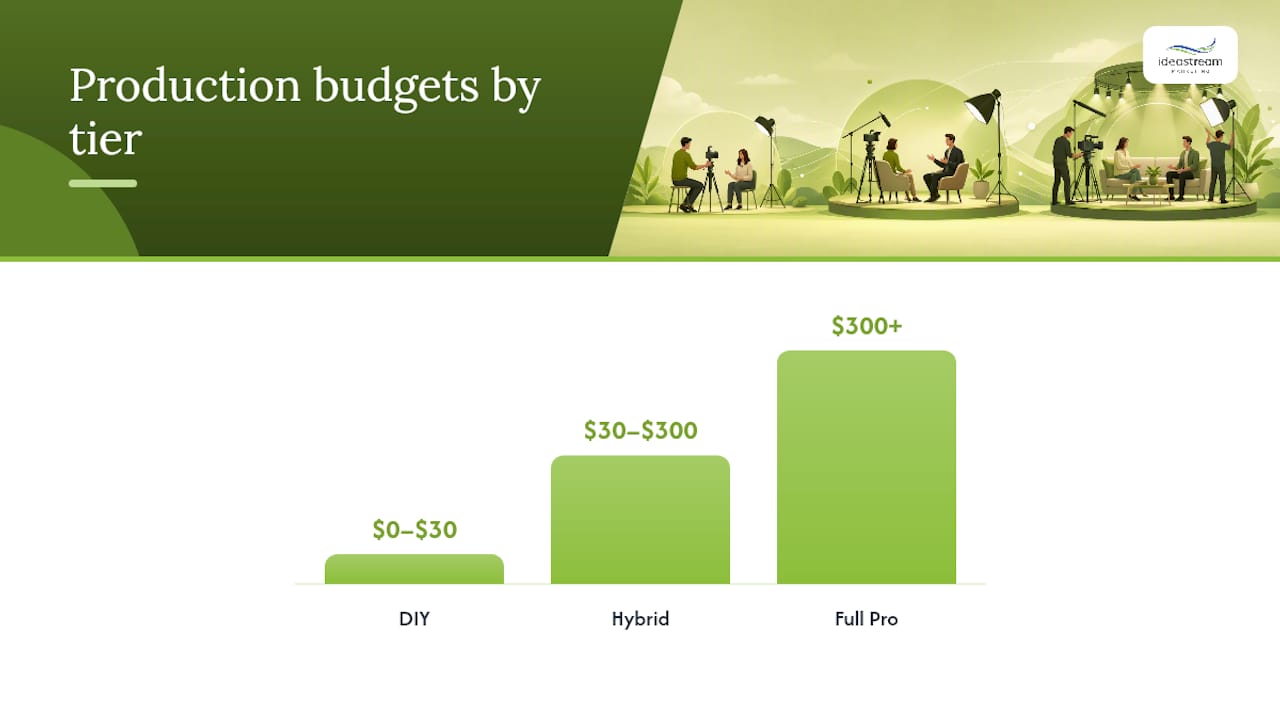
| Factor | DIY | Hybrid | Full Pro |
|---|---|---|---|
| Primary placement | Social, product page | Landing page, YouTube | Hero, paid ads, sales decks |
| Budget | $0–$30 | $30–$300 | $300+ |
| Customer comfort | High (self-record) | Medium (guided remote) | Any |
| Audience expectations | Casual, peer-level | Professional | Enterprise, high-stakes |
What DIY requires
A modern smartphone, a ring light or a window with natural light, and a lapel microphone (available for under $30) will produce a video that converts. The non-negotiables:
- Film with the camera at eye level, never below the chin.
- Use a plain, uncluttered background or a branded environment.
- Record audio separately if possible; built-in phone audio in a quiet room is the minimum acceptable standard.
- Shoot horizontal (16:9) for YouTube and website; vertical (9:16) for Instagram Reels and TikTok.
What hybrid adds
A hybrid approach typically means a remote recording session using a tool like Riverside.fm or Squadcast, where a producer guides the customer through the questions live while capturing high-quality audio and video remotely. This is the sweet spot for most B2B testimonials: it feels personal, produces professional-grade files, and requires no travel.
What full pro delivers
An on-site crew brings a camera operator, a lighting setup, a dedicated audio engineer, and a director who can coach the speaker in real time. You get multiple camera angles, controlled lighting, and B-roll shot on location. For a video that will run as a paid ad or anchor a homepage hero section, the production quality signals credibility before the speaker says a word.
Shot list that matters most for trust:
- Face-to-camera close-up (the primary trust signal)
- Customer using your product or service in their environment
- On-site logo or branded signage visible in the background
- Team or facility B-roll that establishes scale
How to edit interviews into persuasive, platform-ready testimonial videos
The edit is where most testimonial videos lose their impact. Interviews run long, speakers repeat themselves, and editors default to a linear cut that buries the best moment at the three-minute mark. The fix is simple: lead with the result.
Pull the single strongest line from the interview, the moment where the customer states a specific outcome, and open the video with it. Then build the story backward into context and forward into the recommendation. This is the same structure that makes news writing effective: the most important information first.
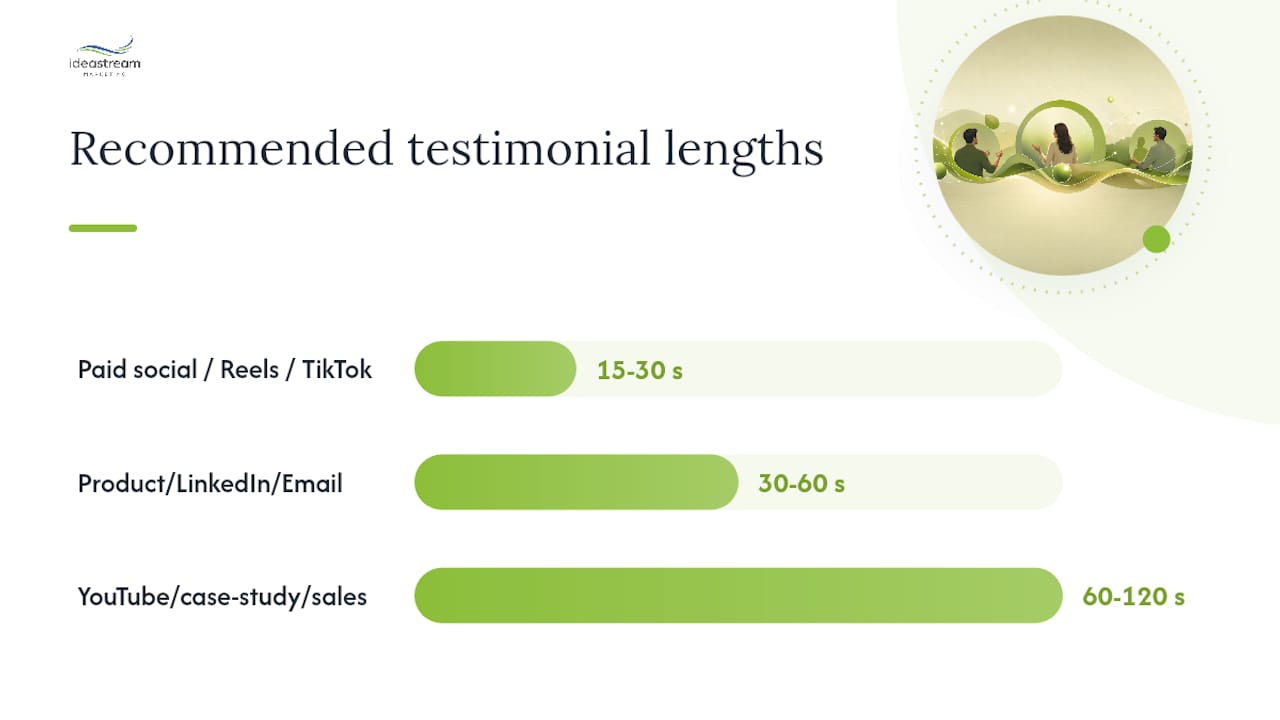
Length guidance by platform:
- 15–30 seconds: Paid social, Instagram Reels, TikTok. One metric, one face, one CTA.
- 30–60 seconds: Product pages, LinkedIn posts, email embeds. Room for context and one result.
- 60–120 seconds: YouTube, case-study landing pages, sales follow-up. Full five-part structure.
Research on video testimonial best practices consistently points to shorter runtimes as the higher-performing choice for social placements, with under-60-second clips generating stronger completion rates and engagement.
Pacing and cut rules:
- Remove every “um,” “you know,” and false start. Viewers notice hesitation more in testimonials than in any other video format because they are evaluating credibility.
- Insert visual proof (a screenshot of a dashboard, a before-and-after metric, a product in use) at the moment the speaker mentions a result. The visual confirms the claim.
- Cut to a second camera angle or B-roll every 15–20 seconds to maintain visual interest.
Export and optimization checklist:
- Add captions in SRT format; burn them in for social, keep them as a separate file for YouTube.
- Export at 1080p minimum; 4K for hero placements.
- Choose a thumbnail that shows the speaker mid-sentence with an expressive face, not a neutral pose.
Pro Tip: One interview produces multiple assets. A 90-second case-study video also yields a 30-second social cut, a 15-second paid ad, a quote graphic for LinkedIn, and an audiogram for podcast promotion. Plan the repurposing strategy before you shoot, not after.
Completion rate signal: B2B video marketing data shows that short-form video under 60 seconds performs especially well for social ROI, making the 15–30 second social cut a priority deliverable for any testimonial shoot.
Where should you publish testimonial videos and what should you measure?
Placement determines performance more than production quality. A well-produced testimonial video on the wrong page will underperform a phone-recorded clip placed directly above a “Buy Now” button.
Placement priority, in order:
- Homepage hero or above-the-fold section: Highest-traffic, highest-stakes real estate. Use your strongest testimonial here.
- Product or service pages: Place testimonials from customers who match the buyer persona for that specific page.
- Pricing page: This is where purchase anxiety peaks. A testimonial that addresses value or ROI directly on this page reduces friction.
- Proposal decks and sales follow-up emails: A personalized video testimonial from a customer in the same industry as your prospect is one of the most effective sales tools available.
- YouTube and LinkedIn: For B2B buyers, these are research channels. A well-optimized testimonial on YouTube can surface in searches your prospects are already running.
- Paid social (Meta, LinkedIn Ads): Short-form testimonial clips as ad creative consistently outperform brand-produced promotional ads in click-through rate.
For a deeper look at how video marketing strategies connect to funnel stages, the framework applies directly to testimonial placement decisions.
KPIs to track:
| Metric | What it tells you | Where to measure |
|---|---|---|
| View rate | Are people choosing to watch? | YouTube Analytics, Meta Ads Manager |
| Watch completion rate | Is the content holding attention? | YouTube, Wistia, Vimeo |
| On-page conversion lift | Is the video moving buyers to act? | Google Analytics (A/B test) |
| CTR from social | Is the thumbnail and hook working? | Meta Ads Manager, LinkedIn Campaign Manager |
| Sales cycle length | Is the video compressing the decision timeline? | CRM (compare deals with/without video touch) |
Tracking tips:
- Tag every video URL with UTM parameters so you can trace traffic from a specific testimonial to a specific conversion.
- Run an A/B test on your highest-traffic landing page: version A with the testimonial video, version B without. Even a two-week test will show directional data.
- Use event tracking in Google Analytics 4 to fire an event when a visitor plays the video, and compare conversion rates between viewers and non-viewers on the same page.
- In your CRM, tag deals where a testimonial video was shared in the sales process and compare average close rates and cycle length against untagged deals.
For guidance on measuring video ROI and aligning video assets to business objectives, that framework pairs directly with the KPIs above.
What does a testimonial video actually cost, and how long does it take?
Budget and timeline vary by production path, but the ranges below reflect realistic U.S. market rates in 2026. These are not minimums or aspirational figures; they are what you should expect to pay and plan for.
| Production tier | Budget range | What you get | Typical timeline |
|---|---|---|---|
| DIY / self-recorded | $0–$30 | Customer records on their own device; you provide prompts and basic editing | 1–2 weeks from ask to published |
| Hybrid / remote pro | $30–$300 | Remote recording session with a producer; professional editing, captions, thumbnail | 2–3 weeks from ask to published |
| On-site full production | $300+ | On-location crew, multiple cameras, B-roll, motion graphics, multiple cutdowns | 4–8 weeks from ask to published |
The biggest timeline variable is not production; it is approvals. B2B customers often require legal review of the script, the release form, and the final cut before they sign off. Build two approval rounds into your timeline, and send the release form at the same time as the initial ask, not after filming.
Primary cost drivers to watch:
- Travel and crew day rates if filming on location
- Number of cutdowns required (each additional format adds editing time)
- Licensed music (budget $50–$300 per track for royalty-free; more for sync-licensed commercial music)
- Motion graphics and animated lower-thirds
- Legal review time on the customer’s side (outside your control, but factor it in)
Your production checklist and interview question templates
Pre-production checklist
- Identify the customer and confirm their availability and willingness to participate.
- Send the one-page approval packet (questions, usage rights, time commitment, sample video).
- Collect a signed release form before scheduling the shoot.
- Brief the customer: share the three questions in advance so they can think, not memorize.
- Confirm the filming location, lighting setup, and audio equipment.
- Prepare B-roll shot list specific to the customer’s environment.
Shoot-day checklist
- Test audio levels before the interview begins; bad audio kills a good testimonial faster than bad lighting.
- Frame the speaker with their eyes in the upper third of the frame.
- Record a 30-second test clip and review it before the full interview.
- Ask each question twice if the first answer is strong; a second take often produces a tighter, more quotable version.
- Capture at least 5 minutes of B-roll: product in use, team at work, branded environment.
- Get a clean close-up of any logo, signage, or product that will appear on screen.
Post-production checklist
- Pull the strongest result statement and use it as the opening line.
- Cut to final length per platform (15–30s social, 30–60s product page, 60–120s case study).
- Add captions and review for accuracy.
- Export platform-specific versions (16:9 for YouTube/website, 9:16 for Reels/TikTok, 1:1 for LinkedIn feed).
- Select and test at least two thumbnail options.
- Add video SEO metadata (title, description, tags, schema markup) before publishing.
Interview question bank
For product pages and e-commerce:
- “What were you trying to solve before you found us?”
- “What made you choose us over other options?”
- “What’s one result you can point to since you started using [product]?”
For B2B sales follow-up and case studies:
- “Can you describe where your business was before we started working together?”
- “What specific outcome can you attribute to this partnership?”
- “Who else in your industry do you think would benefit from working with us?”
For service businesses and professional services:
- “What was the moment you knew this was the right decision?”
- “How would you describe the experience to a colleague who asked about it?”
- “What would you tell someone who’s on the fence about hiring us?”
Pro Tip: Send the questions to the customer 48 hours before the shoot, but tell them not to prepare scripted answers. You want them to think about the story, not rehearse lines. Rehearsed answers sound rehearsed.
How Idea Stream Marketing produces testimonial videos
We approach every testimonial video project as a two-part deliverable: a story that converts, and an asset that gets found.
Our process runs from discovery through delivery in five stages:
- Distribution and optimization: We apply video SEO best practices including metadata, schema markup, and YouTube optimization so the video surfaces in search results, not just on the pages where you manually place it.
VideoTestimonials.video’s ROI data documents that testimonial videos compound value because a single asset reused across landing pages, social, and sales materials multiplies ROI versus channel-limited content. Our deliverable structure is built around that principle: one shoot, multiple assets, measurable returns across every channel.
We serve businesses throughout Long Island, New York City, and nationwide, across healthcare, professional services, hospitality, manufacturing, and growth-focused organizations of every size.
Key Takeaways
The single most important thing you can do with a testimonial video is place it on a conversion page and A/B test it before distributing it anywhere else.
| Point | Details | ||||
|---|---|---|---|---|---|
| Lead with the result | Open every testimonial video with the customer’s strongest outcome statement, not their backstory. | ||||
| Use the five-part structure | Context, problem, solution, specific results, and recommendation keeps runtime tight and covers every persuasion beat. | ||||
| Conversion-page placement first | Place the video on your highest-traffic purchase or decision page before distributing to social or YouTube. | ||||
| Collect consent before filming | Send the release form with the initial ask; waiting until after filming creates approval delays that kill momentum. | ||||
| Ideastreammarketing delivers multiple assets | One shoot produces a full case-study video, a 30-second social cut, a 15-second ad, captions, thumbnails, and SEO-optimized metadata. |
What most people get wrong about testimonial videos
The conventional wisdom says production quality is the deciding factor in whether a testimonial video converts. Spend more, get better results. That’s not what the evidence shows.
The most consistent predictor of testimonial video performance is customer selection, not camera quality. A credible customer with a specific, quantifiable result will outperform a vague endorsement from a recognizable name every time. The viewer is not evaluating the production; they are evaluating whether the person on screen is like them and whether the result is real.
The second mistake is asking too late. Most businesses request testimonials at renewal, when the customer’s enthusiasm has cooled and the specific details of their early wins have faded. The ask should happen at the moment of peak satisfaction, which is usually within two to four weeks of a measurable result. That’s when the story is vivid, the emotion is genuine, and the customer is most likely to say yes.
The third pattern worth noting: approval delays kill more testimonial programs than budget constraints do. A customer who enthusiastically agrees to participate in January can still be waiting on legal sign-off in March. The fix is to send the release form with the initial outreach, not after filming. Getting legal review started early is the single most effective way to compress the timeline.
For teams scaling a testimonial program beyond one or two videos, the compounding effect is real. A library of 10–15 testimonials covering different buyer personas, industries, and use cases gives your sales team a personalized asset for almost every prospect conversation. That’s where the ROI math starts to look genuinely impressive.
Idea Stream Marketing can handle your testimonial video production end to end
If you’ve read this far, you have a clear picture of what a high-performing testimonial video requires: the right customer, a structured story, professional production, and a distribution plan that puts the video in front of buyers at the right moment.
Idea Stream Marketing handles all of it. Our video production services cover everything from the initial customer brief and release forms through on-location filming, professional editing, multiple cutdowns, captions, thumbnails, and video SEO optimization. We don’t hand you a file and wish you luck; we build the asset with its placement and discoverability already planned.
For businesses that also want help distributing and measuring testimonial videos through paid social, YouTube, or managed SEO, our digital marketing services run alongside production so the creative and the strategy stay aligned.
To get a fast, accurate estimate, have these ready when you reach out: your primary objective (conversion page, sales tool, or brand awareness), the customer you have in mind, your preferred timeline, and a rough budget range. That’s enough for us to scope the project and recommend the right production tier.
Contact us to get started or explore our video in advertising capabilities to see how testimonial content fits a broader paid media strategy.
Further reading and authoritative sources
- Statista — Online video time spent
- Content Marketing Institute — 2020 B2B research (PDF)
- The ROI of Video Testimonials: What the Data Says in 2026 | VideoTestimonials Blog
- B2B Video Testimonials: The Complete Playbook | VideoTestimonials Blog
- 15 Video Testimonial Best Practices That Actually Work
- Get Up to Speed on Testimonial Videos – MNTN Research
- B2B Video Marketing Statistics 2026: 50+ Stats (91% Use Video)
- Customer Testimonial Videos (YouTube playlist)
FAQ
What is a customer testimonial video?
A customer testimonial video is a short recorded statement from a real customer describing their experience with a product or service, typically covering the problem they faced, why they chose the solution, and the specific result they achieved. It differs from a written review in that the viewer can evaluate the speaker’s credibility, emotion, and authenticity directly.
What should a customer testimonial video include?
Every effective testimonial video includes five elements: the customer’s context (who they are and what they do), the problem they were solving, why they chose your solution, a specific measurable result, and a direct recommendation to a defined audience. Name, title, and company should appear on screen as a lower-third graphic.
How long should a testimonial video be?
Length depends on placement: 15–30 seconds for paid social and short-form platforms, 30–60 seconds for product pages and LinkedIn, and 60–120 seconds for case-study landing pages and YouTube. Shorter is almost always better for social; the full five-part structure fits comfortably in 90–120 seconds for B2B case studies.
Do you need a release form for a customer testimonial video?
Yes. A signed release form is required before publishing any customer testimonial video. The release should cover the right to use the customer’s name, likeness, and company name, the platforms where the video will appear, and logo usage rights. Collect the signed release before filming, not after, to avoid approval delays.
Can Ideastreammarketing produce testimonial videos for businesses outside Long Island?
Yes. Ideastreammarketing serves clients throughout Long Island, New York City, and nationwide. Remote hybrid production sessions are available for customers in any location, and our team travels for on-site full-production shoots when the project warrants it.