



September 18, 2026



Multi-location SEO is an operational system, not a checklist. It makes every storefront discoverable and trustworthy to both search engines and AI tools. The first move: build one authoritative, unique landing page per verified location, align it exactly with that location’s Google Business Profile, and confirm your name, address, and phone number match everywhere. Do that before touching anything else.
TL;DR:
- Building unique, locally tailored landing pages with accurate NAP data, location-specific content, and modular templates ensures better rankings and avoids suppression as doorway pages.
- Managing Google Business Profiles at scale requires bulk verification, strict governance of core data fields, and regular audits to prevent suspensions and outdated information.
- Implementing a location-specific review collection system, timely responses, and localized review responses strengthen local signals and improve rankings.
- Consistent citation management, regular audits of duplicate or conflicting listings, and high-quality local backlinks from industry or community sources are crucial for authority and trust.
- Optimizing mobile user experience with fast-loading, prominent call-to-action buttons, and accurate schema markup significantly enhances local search visibility and engagement.
Table of Contents
- What Makes Location Landing Pages Rank (Instead of Getting Filtered as Doorway Pages)
- How Do You Verify and Govern Google Business Profiles at Scale?
- Building a Review Engine That Doesn’t Rely on Luck
- Why NAP Consistency Still Breaks Rankings (and How to Fix It)
- Which Local Backlinks and Partnerships Actually Move the Needle?
- What Schema Markup Do Multi-Location Pages Actually Need?
- How Do You Track Marketing Performance by Location?
- What Should You Publish at the Brand Level vs. the Location Level?
- How Do You Get Recommended by AI Search Tools Across Locations?
- What Operational Structure Keeps Multi-Location SEO From Falling Apart?
- How Do You Manage Listings Across Bing Places, Yelp, and Beyond
- How Do You Fix Duplicate Listings and Conflicting Directory Data
- How Should Paid Local Ads Support Your SEO Strategy
- Why Mobile Experience Decides Local Search Outcomes
- How Do You Analyze Competitors for Each Individual Location?
- An Editorial Perspective on Scaling Local Visibility
- Ready to Scale Your Locations Without Losing Control of Quality?
- Sources
- FAQ
What Makes Location Landing Pages Rank (Instead of Getting Filtered as Doorway Pages)
A location page earns rankings when it reads like it was written for that neighborhood, not copied from a template and given a new city name. Google and AI crawlers alike can spot a doorway page in seconds: same paragraph structure, same stock photo, only the city swapped out. Search Engine Land’s framework for geographic pages puts it plainly: build a location ecosystem, not a mass-produced batch. Each page needs its own clarity and its own authority.
Every location page needs these elements, filled in with real, location-specific information:
- Exact NAP (name, address, phone) matching your Google Business Profile character for character
- Hours of operation, including seasonal or holiday variations
- An embedded map and driving directions from major nearby landmarks
- Services or products offered at that specific location (not the full company catalog)
- Staff bios or a photo of the team who actually works there
- Location-specific testimonials or a short case study from a local client
Aim for a significant portion of the page’s text to be unique to that locality, incorporating details about the neighborhood, local landmarks, or community events. That means writing about the neighborhood, the specific parking situation, a local landmark used for directions, or an event the team sponsored. Backlinko’s playbook for scaling multi-location SEO recommends building modules like local case studies and staff spotlights specifically because these resist the copy-paste trap that gets pages devalued.
On the technical side, host location pages in subfolders (yoursite.com/locations/city-name) rather than subdomains. Subfolders inherit domain authority more efficiently and keep your internal linking structure simple. Use canonical tags only when two pages legitimately overlap in content; never use them to mask duplicate location pages you were too rushed to differentiate.
For scaling past a handful of locations, build modular templates in your CMS: a fixed skeleton (NAP block, map, services grid) with clearly marked open slots for unique content as explained in Scalable SEO – Why It’s Vital for Agency Growth. Populate each slot from a master data repository, then run a uniqueness check, comparing new pages against existing ones, before anything goes live.
Pro Tip: Give your local managers a short list of “local fact” questions to answer for their page (nearest cross street, favorite regular customer story, most-requested service) instead of asking them to “write something local.” Specific prompts produce specific, useful content.
How Do You Verify and Govern Google Business Profiles at Scale?
If you manage 10 or more eligible locations, you can request bulk verification through Google Business Profile Manager instead of verifying each listing one by one. The process runs like this:
- Confirm every location meets Google’s eligibility and quality guidelines before submitting.
- Compile a spreadsheet with standardized fields: exact business name, address, phone, primary category, and website URL for each location.
- Submit the spreadsheet through Business Profile Manager and group locations into a business group for centralized management.
- Assign role-based access so regional managers can update photos and posts, while only a small central team can change core NAP data or category.
- Monitor the verification queue and resolve flagged mismatches individually rather than resubmitting the entire batch.
Business groups matter because they let you push category or attribute updates across a set of profiles at once, which is critical once you’re past a dozen locations. But a handful of fields need governance discipline no automation can replace:
- Primary business category must stay consistent unless a specific location genuinely differs
- NAP fields must match the master repository exactly, including suite numbers and abbreviations
- Hours must reflect real-time changes, including holiday schedules, updated the same week every year
- Website URL should point to that location’s specific landing page, not the homepage
For holiday hours or temporary closures across dozens of profiles, listings management platforms like Semrush Local or BrightLocal can push bulk updates faster than manual entry. Reserve manual review for suspended profiles or flagged duplicates. Suspensions almost always trace back to a mismatch between what’s in the profile and what’s on the website, so your escalation path should start there before you file an appeal.
Building a Review Engine That Doesn’t Rely on Luck
Review velocity and quality are ranking signals now, not just trust signals. Waiting for reviews to trickle in organically is the slowest way to build them. Set a post-transaction trigger instead: the moment a service is completed or a purchase closes, an automated message goes out with a short, location-specific review link or QR code.
Timing matters more than most teams assume. Send the initial request within two hours of the transaction, while the experience is still fresh, and follow up once more at the 48-hour mark if there’s no response. Integrate the trigger directly with your point-of-sale or CRM system so no team member has to remember to send it manually.
- Route every review, across every platform and location, into one centralized monitoring dashboard
- Set a response SLA (24 to 48 hours) for all reviews, positive or negative
- Escalate any review mentioning safety, billing disputes, or legal threats to a manager immediately
- Respond to negative reviews with a specific acknowledgment and an offline resolution path, never a copy-paste apology
- Treat every fresh review as a new local signal, not just reputation management
Pro Tip: Ask your team to mention the service performed and the neighborhood in their review responses when it’s natural to do so. “Thanks for trusting us with your kitchen remodel in Huntington” reinforces local relevance far better than a generic “Thanks for the review!”
Why NAP Consistency Still Breaks Rankings (and How to Fix It)
Inconsistent business information across the web confuses the entity signals search engines and AI systems use to confirm a location is real and trustworthy. A citation listing “Suite 4” when your Google Business Profile says “Ste. 4B” is a small inconsistency that adds up across dozens of directories into a real ranking drag.
Fix it with a repeatable system:
- Build a master location data repository, ideally a single spreadsheet or database, with character-for-character formatting for every NAP entry.
- Distribute that master data to citation platforms and directories through a listings aggregator, and log exactly where each citation was published.
- Run a full citation audit quarterly, checking for duplicate listings, outdated addresses, and directories still showing a previous owner’s business name.
- Build a remediation playbook: who requests the correction, which platform’s support process to use, and how long you’ll wait before escalating.
Acquisitions and rebrands are where this discipline usually collapses. A business that changes its name, moves two blocks over, or gets absorbed into a larger brand almost always leaves a trail of outdated citations that actively contradict the new NAP. Treat every acquisition or relocation as a full citation re-audit, not a quick update to the flagship listing.
Which Local Backlinks and Partnerships Actually Move the Needle?
Not all local links carry equal weight. A mention from the local chamber of commerce or a regional news outlet does more for entity trust than a dozen low-value directory submissions ever will.
- Prioritize outreach to local press, chambers of commerce, event sponsors, and industry associations tied to each specific location
- Build a backlink opportunity tracker that logs contact info, outreach date, and follow-up status per location
- Create standard outreach templates, then customize the first paragraph with something specific to that publication or organization
- Sponsor a local event and request a link from its recap or sponsor page, which tends to be one of the easiest links to earn
- Publish your own local resource pages (a guide to a neighborhood event, a partnership recap) that naturally attract mentions
- Track link impact per location in your reporting rather than lumping all backlinks into one company-wide metric
- Avoid link farms and paid directory networks; they add citation noise without adding real corroboration
A single link from a regional business journal covering your store opening does more for that location’s authority than fifty generic directory listings. Treat local link building as a location-by-location campaign, not a blanket outreach blast.
What Schema Markup Do Multi-Location Pages Actually Need?
Every location page needs its own LocalBusiness JSON-LD block, and it needs to match the page’s visible content exactly. Search Engine Journal’s framework for multi-location organizations notes that unique content combined with accurate schema is what keeps AI and indexing systems from treating a location page as a thin doorway page.
- Include name, address, phone, hours, geo-coordinates, and
sameAslinks back to that location’s Google Business Profile and social profiles - Store JSON-LD in a template that pulls directly from your master data repository, so a NAP update in one place updates every page automatically
- Use industry-specific schema subtypes where they apply:
MedicalBusiness,LegalService,Restaurant, rather than the genericLocalBusinesstype - Double-check geo-coordinates against the actual building, not just the city center, especially for strip-mall or multi-suite addresses
- Validate every page’s markup after any template change; a single syntax error can silently break structured data across every location at once
Pro Tip: Run a spot check on five random location pages every quarter, comparing the visible hours on the page against what’s in the schema and what’s live on Google Business Profile. Stale hours are the single most common mismatch we catch. Idea Stream Marketing’s guide to syncing LocalBusiness schema with your CMS walks through the sync process step by step.
How Do You Track Marketing Performance by Location?
Attribution is where most multi-location programs fall apart. Corporate sees an overall traffic bump and has no idea which of twelve locations actually drove it.
- Assign a location ID parameter to every UTM you build, so campaign links and GBP posts both carry that identifier through to your analytics.
- Rely on GA4’s native Google Business Profile integration for surface-level actions like calls, direction requests, and website clicks, then layer UTMs on top when you need a more granular breakdown by campaign or channel.
- Set up call tracking, using a platform like CallRail, with a unique tracking number assigned to each location so every call resolves to a specific address.
- Tie form submissions to the same location ID so a lead from your Huntington page and a lead from your Riverhead page never get lumped together in one report.
- Build a Looker Studio dashboard that rolls all location data into one view, with a filterable KPI scorecard for each address.
| Attribution layer | What it captures | Best used for |
|---|---|---|
| UTM with location ID | Campaign source, medium, and specific location | Paid ads, email, and GBP post links |
| GA4 native GBP integration | Calls, direction requests, website clicks from the profile | Quick profile-level performance checks |
| Call tracking (e.g., CallRail) | Phone leads by location | Locations where calls outweigh web forms |
| Looker Studio dashboard | Combined view across all sources | Monthly and quarterly leadership reporting |
What Should You Publish at the Brand Level vs. the Location Level?
A hub-and-spoke model keeps location pages from duplicating each other while still building topical authority company-wide. The hub, usually a services or resources section, covers broad topics once. Each location page (the spoke) links back to the hub and adds only what’s genuinely local.
- Map every core service or topic to one hub page, then link each relevant location page to it, and vice versa
- Build local content templates: neighborhood guides, staff spotlights, location-specific case studies, and event recap pages
- Set a uniqueness threshold for every piece of local content and require an editorial review before anything publishes
- Repurpose your podcast and video content into location-specific assets: a customer testimonial filmed at one branch, a short clip about a location’s team, or a recap video from a sponsored local event
This is where content production and SEO strategy actually meet. A five-minute interview with a location manager, cut into a short vertical clip for Instagram Reels or YouTube Shorts, becomes both a social asset and embeddable proof-of-locality content for that page. Idea Stream Marketing’s breakdown of local SEO strategies for visibility and leads covers how content and GBP alignment work together in more depth.
How Do You Get Recommended by AI Search Tools Across Locations?
AI Overviews and chatbot answers don’t trust a single source. They look for corroboration: does your Google Business Profile, your location page, and outside mentions all tell the same story? Search Engine Journal’s research on AI-driven local visibility frames this as an entity trust triangle: complete business data, an authoritative location page, and third-party corroboration, all pointing the same direction.
- Complete every GBP attribute field, not just the required ones; incomplete profiles read as lower-confidence entities
- Earn corroboration from local press, niche directories, and community organizations, not just Google reviews
- Keep structured data accurate so AI systems can extract facts (hours, services, address) with confidence
- Monitor which locations appear in AI Overviews or chatbot answers and track whether that visibility correlates with traffic or calls
Local press mentions and community-site corroboration carry real weight here, because broadening signals beyond Google reviews is exactly what separates locations that get cited by AI tools from ones that don’t.
What Operational Structure Keeps Multi-Location SEO From Falling Apart?
Scaling breaks down not from bad strategy but from unclear ownership. Someone updates a location’s hours locally, nobody tells the central team, and now three data sources disagree.
- Assign a central team to own the master data repository, schema templates, and any core NAP or category changes.
- Let local managers own their own photos, staff bios, and local events, but never core NAP fields.
- Run a daily check on GBP suspension alerts, a weekly sync between central and local teams, and a full quarterly audit of citations and schema.
- Build a clear escalation path for suspensions or data conflicts, and a standing SOP for acquisitions, rebrands, or relocations.
Pro Tip: A weekly 15-minute sync between the central SEO team and one rotating regional manager catches more data drift than any monthly report. Small conflicts are cheap to fix immediately and expensive to unwind six months later.
How Do You Manage Listings Across Bing Places, Yelp, and Beyond
Google Business Profile gets most of the attention, but Bing Places, Yelp, Apple Maps, and industry-specific directories all feed the same entity signals search engines and AI tools cross-reference. A profile that’s accurate on Google but stale on Yelp still creates the kind of contradiction that erodes trust.
Treat every platform as a distribution target for your master data repository, not a separate project. Bing Places allows bulk location import for larger networks, similar in spirit to Google’s bulk verification process, and it’s worth claiming even though its search share is smaller, since Bing results feed into Microsoft’s AI-powered Copilot answers. Yelp weighs review recency and completeness heavily in its own local rankings, so a profile with outdated hours or missing photos underperforms there even if your Google listing is flawless.
Assign one owner per platform group rather than treating each directory as a one-off task. A listings management platform can push updates to secondary platforms simultaneously once your Google and Bing data is confirmed accurate, cutting the manual workload dramatically for networks with dozens of locations. Reserve manual login-by-login updates for platforms that don’t support bulk tools or that flag your business for verification.
Review each platform’s specific fields before assuming they mirror Google’s format. Some directories cap category selections differently, or format phone numbers without the standard formatting your master data uses. A field that looks correct at a glance can still create a subtle mismatch that undermines the consistency you’ve built everywhere else.
How Do You Fix Duplicate Listings and Conflicting Directory Data
Duplicate listings usually trace back to one of three causes: a previous business at the same address, a location that got manually added by a well-meaning employee, or a data aggregator that pulled outdated public records. Whatever the cause, duplicates split your review count, confuse customers, and dilute the entity signals a single accurate profile would send.
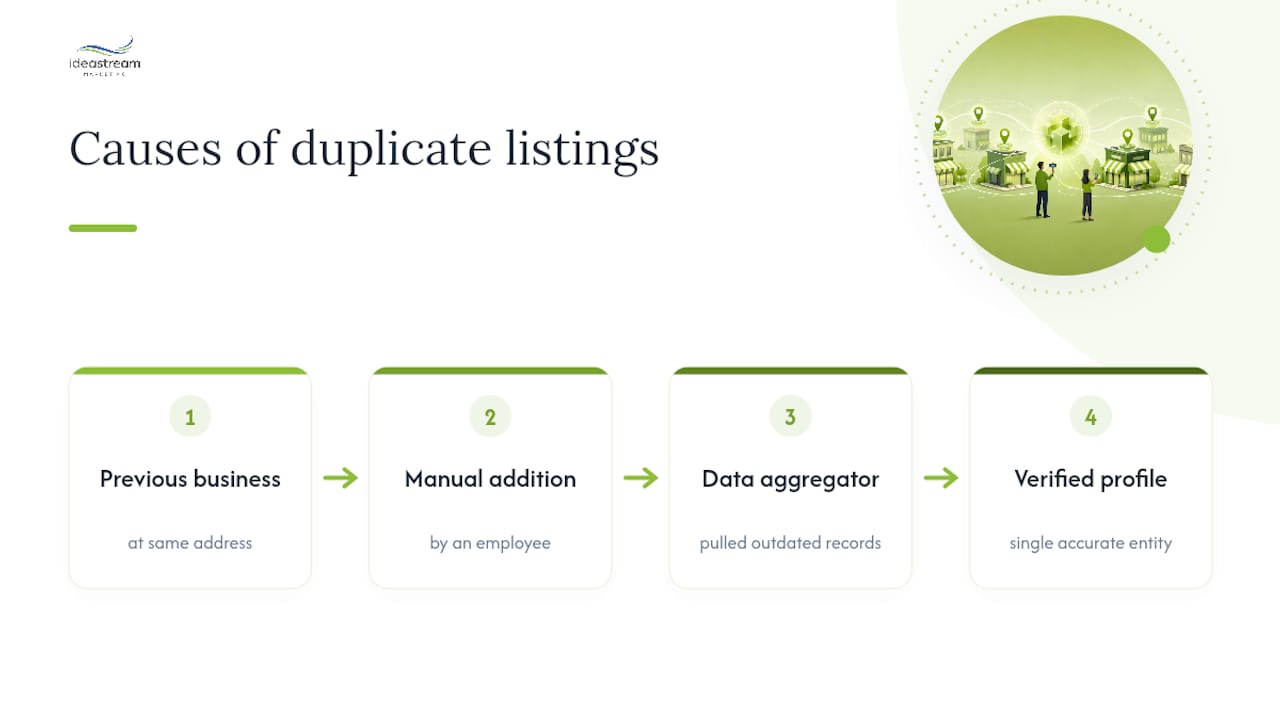
Start by searching your business name plus city across Google, Bing, and Yelp to surface duplicates directly. Google’s merge process requires claiming both listings and requesting a merge through Business Profile support, which can take days to process, so build that lag time into any launch or relocation timeline. For directories without a formal merge tool, request removal of the outdated listing directly and point to your verified, active profile as the source of truth.
Conflicting information (an old address, a disconnected phone number, a former owner’s business name) does more damage than a straightforward duplicate, because it actively contradicts your current NAP rather than just doubling it. Prioritize fixing conflicts on high-authority directories first, since those carry more weight in citation-based trust scoring than smaller, low-traffic listings.
Build this into your quarterly citation audit rather than treating it as a one-time cleanup. New duplicates surface constantly, especially after a relocation, a name change, or a listing aggregator’s periodic data refresh pulling from outdated public records.
How Should Paid Local Ads Support Your SEO Strategy
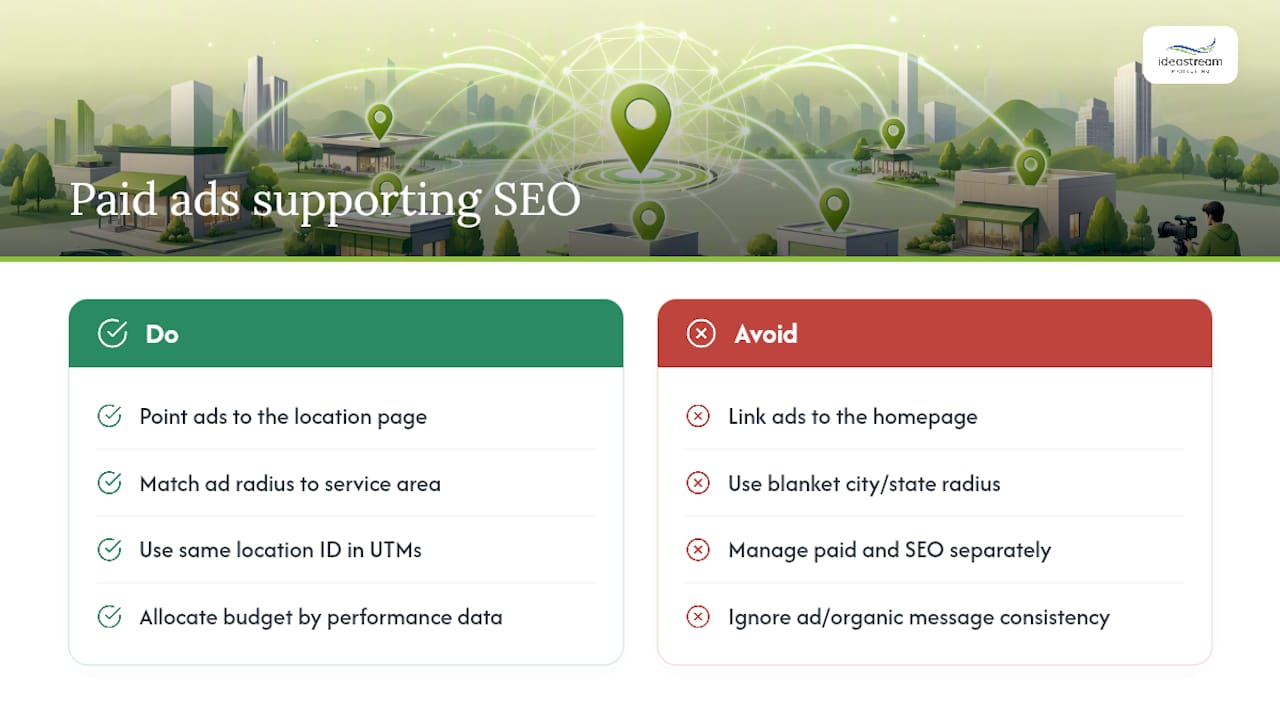
Geo-targeted paid advertising and organic multi-location SEO should reinforce each other, not run as separate budgets managed by separate teams. When a location’s Google Ads campaign points to the same landing page your SEO strategy is optimizing, both efforts compound: paid clicks generate engagement signals, and a well-optimized organic page converts paid traffic more efficiently than a generic homepage would.
Match your ad geo-targeting radius to the service area each location actually covers, not a blanket citywide or statewide radius that wastes spend on unreachable customers. Use the same location ID in your paid UTM parameters that you use for organic tracking, so your Looker Studio dashboard can compare paid and organic performance for the same address side by side instead of in separate reports.
Local service ads and standard geo-targeted search campaigns should link directly to the location page, never the homepage. A homepage forces the visitor to search for their nearest branch, adding friction that geo-targeted ads are specifically designed to eliminate. Test ad copy that references the neighborhood or landmark used in your organic content; consistency between paid messaging and organic content reinforces the same local relevance signals to the person clicking, even if it doesn’t directly influence rankings.
Budget allocation should follow the same performance data driving your organic priorities. A location generating strong organic visibility but weak conversion might need paid support at the bottom of the funnel, while a newer location with limited organic authority often benefits more from broader paid reach while its content and citations build up.
Why Mobile Experience Decides Local Search Outcomes
Local searches skew overwhelmingly mobile. Someone typing “plumber near me” or tapping a Google Maps result is very likely doing it from a phone, often while standing in a driveway deciding who to call in the next sixty seconds. A location page that loads slowly or buries the phone number below three scrolls loses that customer to a competitor’s listing.
Click-to-call buttons should sit above the fold on every location page, not tucked into a footer. The same goes for the embedded map and directions link; mobile users searching by location are frequently trying to navigate somewhere, not just browse. Test your location pages specifically on mobile, not just on a desktop browser resized smaller, since mobile rendering can hide or compress elements that only display correctly with a mouse cursor.
Page speed matters even more locally than it does site-wide, because a mobile user with poor cell signal in a parking lot has less patience for a slow-loading page than someone at a desk with fiber internet. Compress images, especially the location photos and staff bios your uniqueness strategy depends on, since a page loaded with high-resolution, unoptimized images undermines the very content meant to build trust.
Structured data and schema markup also feed mobile-specific search features: the “hours” and “call” buttons that appear directly in mobile search results often pull from your schema and GBP data rather than the visible page content, which is one more reason schema accuracy and mobile experience are tied together operationally, not just technically.
How Do You Analyze Competitors for Each Individual Location?
Treat every location as its own competitive market, not a single line item in a company-wide competitor report. The plumber three blocks from your Riverhead branch is a completely different competitive threat than the one competing with your Huntington location, even though both operate under the same parent brand’s radar.
Search your primary local keywords for each location individually and log which competitors appear in the map pack, not just the organic results. Map pack competitors often differ meaningfully from organic search competitors, since map rankings weigh proximity, review signals, and GBP completeness more heavily than backlink profiles or content depth.
Audit each top local competitor’s review count, review velocity, and GBP completeness alongside their location page content. A competitor with double your review count but a thin, generic location page is beatable through content and schema work; a competitor with a strong local page and a fast review velocity requires matching their review acquisition pace, not just their content quality.
Rebuild this competitive snapshot quarterly for each location, since local competitive sets shift faster than most companies expect. A new location opening two miles away, a competitor’s rebrand, or a sudden spike in review velocity from a rival can change a location’s competitive position within weeks, not years.
An Editorial Perspective on Scaling Local Visibility
Most companies treat multi-location SEO as a bigger version of single-location SEO: more pages, more listings, more reviews. That thinking is why so many location page rollouts stall at page forty, buried under duplicate content flags and inconsistent NAP data nobody caught in time. The real differentiator is governance, not volume. A master data repository, clear ownership between central and local teams, and a repeatable audit cadence do more for rankings than another round of generic city pages ever will.
What gets underestimated most is how much local video and audio content amplify everything else on this list. A short interview with a location manager, repurposed into a podcast clip and a vertical video for Instagram Reels or TikTok, gives AI systems and human searchers the exact kind of third-party corroboration the entity trust triangle depends on. Idea Stream Marketing builds that kind of content alongside the technical SEO work precisely because the two reinforce each other; a location page with an embedded local video converts and ranks differently than one with stock photography and a paragraph of filler text.
— Dean Spinato, CEO & Founder of Idea Stream Marketing
Ready to Scale Your Locations Without Losing Control of Quality?
Most agencies hand you a spreadsheet of recommendations and leave the execution to your already-stretched marketing team. Idea Stream Marketing runs the full operational system instead: audits, Google Business Profile governance, location page production, and the tracking dashboards to prove it’s working.
That system gets stronger when it includes real content, not just technical fixes. Our team produces the local video, podcast production, and short-form clips for Instagram Reels, Facebook Reels, and YouTube Shorts that give your location pages the corroboration AI search tools and human customers both look for. A single interview filmed at one branch becomes a location page asset, a social clip, and a review-request touchpoint, all from one afternoon of production.
If you’re managing SEO across multiple locations and the data drift is starting to outpace your team’s bandwidth, our search engine optimization services are built for exactly that operational load. Schedule a consultation to walk through your current location pages, GBP profiles, and citation data, and leave with a clear plan for where the gaps actually are.
Sources
Consult Google’s bulk verification guidance, Backlinko’s scaling playbook, and listings, call tracking, and analytics platforms like Semrush Local, CallRail, and Looker Studio when implementing these steps.
- Bulk location management overview – Google Business Profile Help
- Multi-Location SEO: How to Scale Without the Chaos
- Multi-Location SEO in 2026: A Six-Pillar Framework Backed by SERP Data · Foragentis
FAQ
Is SEO Dead or Still Evolving for Multiple Locations?
SEO isn’t dead; it’s shifted toward entity trust and AI visibility alongside traditional rankings. For multi-location businesses, that means accurate business data, review quality, and consistent citations matter as much now as backlinks did a decade ago.
What Are the Four Types of Local SEO Signals?
Local SEO generally breaks down into four signal groups: on-page relevance (location pages and content), proximity and Google Business Profile data, review signals, and citation or link authority. Multi-location businesses need governance across all four, not just one.
What Is the 80/20 Rule for Multi-Location SEO?
The remaining 20% (backlinks, advanced schema, AI Overview tactics) matters, but only after the foundation is consistent.
How Do You Actually Do Location-Based SEO?
Start by claiming and verifying each Google Business Profile, using bulk verification if you manage 10 or more locations. Then build a unique landing page per location, keep NAP data identical everywhere it appears, and track performance with location-specific UTMs and call tracking.
Does Idea Stream Marketing Offer Multi-Location SEO Services?
Yes. Idea Stream Marketing provides search engine optimization built for businesses managing multiple locations, including GBP governance, location page production, and location-level video content. Pricing is available on request through a consultation.