



October 26, 2026
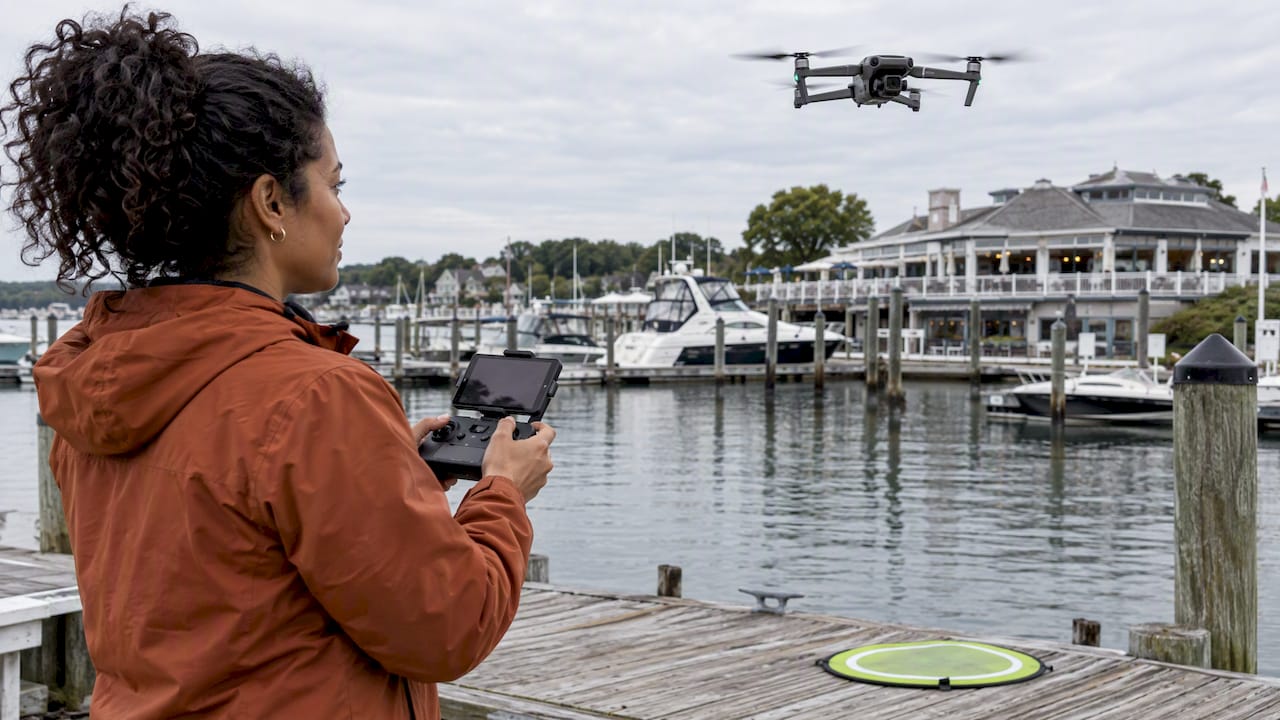

Drone video marketing means using aerial footage to show what ground-level cameras can’t: the scale of a property, the setting of a business, the route to your door. It works best when each clip has a job, such as a homepage hero video, a Reel, a property tour or an event recap, and when a licensed pilot flies it legally. Below we cover the ideas that earn their cost, how to plan distribution, what drone video costs in the US, and the FAA rules that apply when a business flies.
TL;DR
- Drone footage is a visual asset, not a strategy. Pick the goal first (leads, bookings, attendance, recruiting), then decide where the aerial shots add the most.
- The best uses are establishing shots, property and location tours, construction progress, event coverage and short vertical clips cut from a longer shoot.
- Published 2025 rates run about $1,000 to $5,000 per project, and $2,000 to $5,000 for commercial marketing videos. Editing, music and motion graphics move the number.
- Any flight for business purposes falls under FAA Part 107, so confirm your pilot’s certificate and registration before you book.
- Shoot once, then cut the footage for your website, YouTube, Instagram Reels, Facebook Reels, TikTok and YouTube Shorts.
Table of Contents
- What drone video can do for a business
- Drone video ideas that work for business
- Match the footage to the channel
- Set a goal before you fly
- What drone video costs in the US
- Can you make a drone video on a small budget?
- FAA rules for commercial drone video
- Our perspective on drone video marketing
- Work with a Long Island video team
- FAQ
- Sources
What drone video can do for a business
Aerial video gives you camera angles that used to require a helicopter or a crane. Industry research on drone-enabled marketing describes drones being used for aerial imaging, live event coverage and location-based storytelling, folded into conventional digital campaigns. The same research notes that elevated perspectives and hard-to-replicate visuals can make a campaign more distinctive.
That last word matters. A competitor can copy your slogan in a week. It is much harder to copy a sweeping shot of your campus at golden hour, or a clear aerial view that shows customers exactly where your location sits in relation to the highway, the beach or the downtown strip.
For Long Island and New York businesses, the geography does a lot of the work. Waterfront restaurants, marinas, wineries on the North Fork, developments, medical campuses, cemeteries, and contractors with large job sites all have a story that is easier to tell from above.
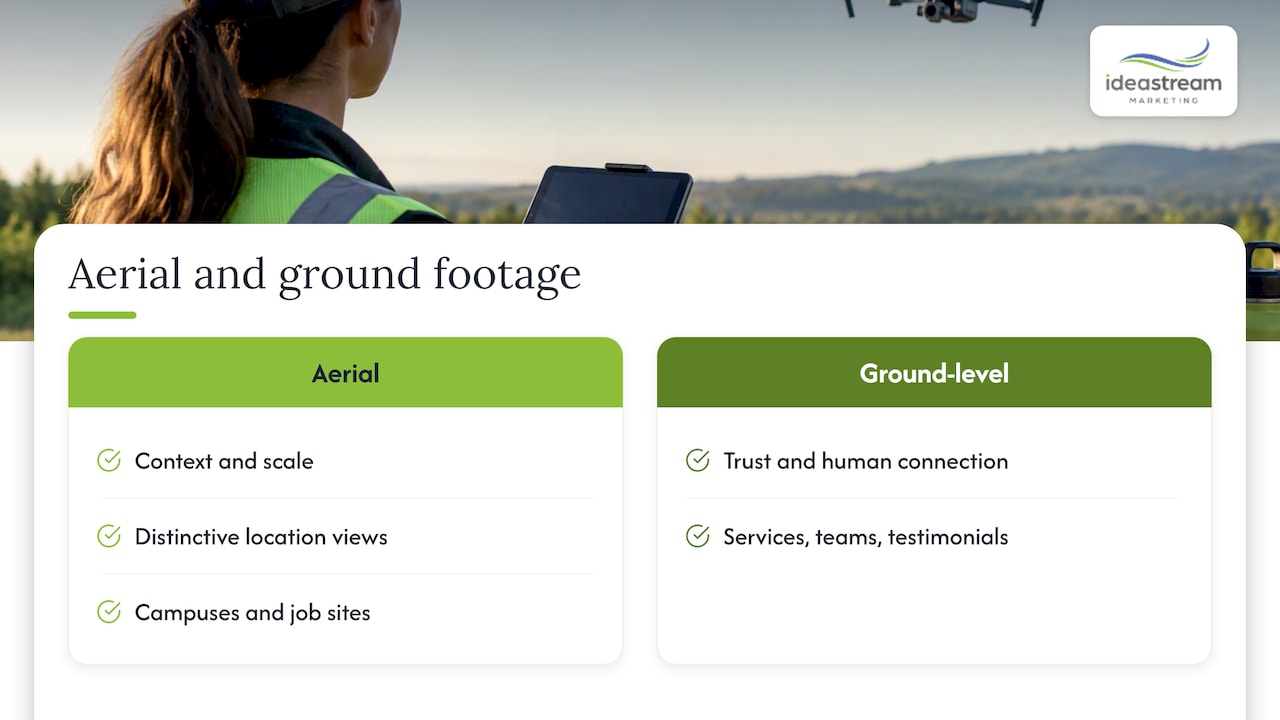
Drone video is not a fit for everything. If you are explaining a service, introducing your team or recording a customer testimonial, an aerial shot adds little. Use it for context and scale, and let ground-level video carry the human parts. Our guide to what video marketing is and how to measure its return covers how the two fit together.
Drone video ideas that work for business
These are the formats we see businesses get the most from. Each one has a clear audience and a clear place to publish.
1. The establishing shot for your homepage
A slow reveal of your building, grounds or neighborhood makes a strong opening for a website hero video or an “About us” page. Keep it short, silent or lightly scored, and compressed so it does not slow the page. Page speed affects both visitors and search visibility, so work with your web team on file size.
2. The fly-through or property tour
A continuous path from the street to the entrance, across the grounds and around the structure helps buyers, renters and event planners picture themselves there. Real estate, hospitality, senior living, schools and venues use this format most. If you market property, our real estate marketing strategies article shows where tours fit in the funnel.
3. Location and access story
A short clip that shows where you are and how easy you are to reach answers a question customers ask all the time. A restaurant with parking and a water view, a medical office next to a train station, a showroom on a busy corridor: the aerial view settles it in ten seconds.
4. Construction and project progress
Contractors, developers and landscape firms can fly the same route monthly and cut the clips into a time-lapse style sequence. It makes a powerful portfolio piece and gives prospects proof of scale.
5. Event coverage and recaps
Festivals, grand openings, charity runs, trade shows held outdoors and community days look bigger from above. Event teams also reuse the footage to sell next year’s sponsorships and tickets. Note that flying over people is prohibited under Part 107 unless they are directly participating in the operation, so a good pilot plans routes and timing around the crowd, not over it.
6. Recruitment and culture video
Showing a campus, a job site or a fleet yard from above tells candidates what kind of operation they are joining. Pair it with employee interviews, as we describe in our piece on recruitment videos that attract better candidates.
7. Product and equipment in context
Manufacturers, boat dealers, solar installers and agricultural suppliers can show equipment working in its real environment, which a studio shot cannot do.
8. Behind-the-scenes content
A short clip of the drone launching, the crew setting up and the pilot checking the shot is often the most shareable piece, because it shows the work behind the finished video.
9. Vertical teasers for social
Cut your best five to ten seconds of aerial footage into 9:16 vertical clips with captions, a hook in the first second and a clear next step. These become Instagram Reels, Facebook Reels, TikTok videos and YouTube Shorts from the same shoot. See our Reels production strategy for the structure we use.
10. B-roll for podcasts and interviews
If you record a business podcast or on-camera interview, aerial shots of your location make clean cutaways and episode intros. They also give your clips a polished look when you repurpose episodes into social media clips.
Match the footage to the channel
The same flight can feed several channels, but each platform has its own shape. Plan the shot list with these in mind before the drone leaves the case.
| Channel | Best use of drone footage | Format to plan for |
|---|---|---|
| Website homepage | Looping hero video or establishing shot | 16:9, short, compressed |
| YouTube | Full tour, project showcase, event recap | 16:9, strong thumbnail, descriptive title |
| Instagram and Facebook Reels | Hook-driven teaser of the best shots | 9:16, captions, under 30 seconds |
| TikTok and YouTube Shorts | Reveal shots, before and after, behind the scenes | 9:16, fast opening |
| Thumbnail or short GIF linking to the full video | Light file, clear button | |
| Paid video ads | Short cut with a call to action | Platform-specific ratios |
The aspect ratios above are standard platform conventions: wide for YouTube and websites, vertical for Reels, Shorts and TikTok. Tell your videographer which versions you need before filming, because framing a shot for 16:9 and later cropping it to 9:16 can cut off the subject. Shooting with both crops in mind costs nothing in the field and saves hours in editing.
For video that ranks, titles, descriptions, transcripts and schema matter as much as the footage. Our video SEO best practices walk through the details.
Set a goal before you fly
Research on drone campaigns recommends designing them around measurable objectives such as qualified engagement, content reuse, attendance or brand lift, rather than novelty alone. That is the right instinct. Before you hire anyone, write down:
- The business goal. More booked tours, more form fills, higher event attendance, more applications.
- The audience. Homebuyers, facilities managers, patients, couples planning a wedding, candidates.
- The placement. Where will this video live, and what will the viewer do next?
- The measure. Views are fine, but track the action: calls, clicks to the contact page, form submissions, tour requests.
- The reuse plan. How many cuts will you make, and in which sizes?
A single half-day shoot can supply a year of content when it is planned this way. That is also why a shoot that includes ground video, photography and drone work tends to cost less per finished asset than booking each separately.
What drone video costs in the US
Pricing is wide because “drone video” covers everything from a ten-minute property flyover to a scripted brand film. Two published guides give useful ranges.
UAV Coach’s 2025 guide lists drone videography at roughly $200 to $500 per hour, or $1,000 to $5,000 per project, including $2,000 to $5,000 for commercial marketing videos. It notes that location, pilot skill, equipment, editing, motion graphics, color grading, licensed music and voiceover all affect the price. A separate pricing guide puts real estate drone video at $100 to $700, depending on property size, flight time and complexity, with other commercial projects ranging from $150 into the thousands.
Here is what typically moves a quote up or down:
- Scope of the flight. One location and one hour is simple. Several sites, a long route or a full-day event is not.
- Post-production. Editing, color grading, titles, music licensing and voiceover are often most of the work.
- Number of deliverables. A 16:9 master plus a set of vertical cuts takes more edit time than a single file.
- Planning and permissions. Scouting, airspace checks and site approvals take time before anyone flies.
- Integration. Footage combined with ground video, interviews or photography is a bigger production than aerial alone.
We do not publish fixed prices because every project differs. We scope drone work together with the rest of the production so you pay for the assets you will actually use.
Can you make a drone video on a small budget?
Yes, with limits. If you only need a simple establishing shot of your location, you have a few realistic options:
- Plan one tight shot list. Three or four planned shots beat an hour of wandering flight.
- Shoot during good light. Early morning and the hour before sunset give you the most flattering footage without added expense.
- Edit with restraint. Slow, steady movement, one piece of licensed music and a short length make footage look professional. Overlays, voiceover or graphics help a clip make its point, as many drone hobbyists discover when they try to use footage for self-promotion.
- Bundle the shoot. If you are already booking video or photography, adding a drone shot list to that day is usually cheaper than a separate visit.
The one place not to economize is legality. If the footage is for your business, the flight must follow the rules below, whoever operates the drone and however small the job.
FAA rules for commercial drone video
Anything that is not purely recreational is a commercial flight in the FAA’s eyes, including shooting a video for your own company. The FAA’s Part 107 summary sets out the main points:
- The pilot needs a Remote Pilot Certificate, or must be directly supervised by a certificate holder.
- Each drone must be registered.
- Operations in Class B, C, D and E airspace need air traffic control authorization.
- Flying over people is prohibited unless they are directly participating in the operation.
Airspace matters in our region. Much of the New York metropolitan area sits under controlled airspace, so authorization checks are part of planning, not an afterthought.
If your business operates its own drone program rather than hiring a pilot, the FAA says you need a Part 107 account on FAA DroneZone, and your drones must be registered in the Part 107 inventory. The person or organization behind the account is ultimately responsible for it.
Some shots, like night flights, require more. The FAA’s waiver program allows specific operations Part 107 does not otherwise permit, if the pilot demonstrates they can be done safely by alternative means. Night operations, for example, run under a waiver with stated conditions.
Questions to ask any drone provider before you sign:
- Does the pilot hold a current Remote Pilot Certificate?
- Is the aircraft registered?
- Will you check airspace and request authorization where needed?
- Does your insurance cover commercial aerial work?
- Do you have a plan for shooting near people, roads and neighboring property?
A professional answers all five without hesitation. Local rules also apply, such as park, beach and municipal restrictions, so ask who is responsible for permissions at your location. For specifics on your situation, the FAA’s own pages and a certified pilot are the right authority.
Our perspective on drone video marketing
Most drone video we see businesses post has the same problem: good footage, no plan. A nice flyover goes on social media, gets a few likes and disappears. We treat aerial shots as one layer in a larger content system.
When we plan a shoot, we start with where the video will be found. That means thinking about Google, YouTube, AI-powered search and social platforms before the first frame, and writing the titles, descriptions and captions that help the video get discovered. The footage then gets cut into the full version, the short vertical clips and the stills your website, email and ads need.
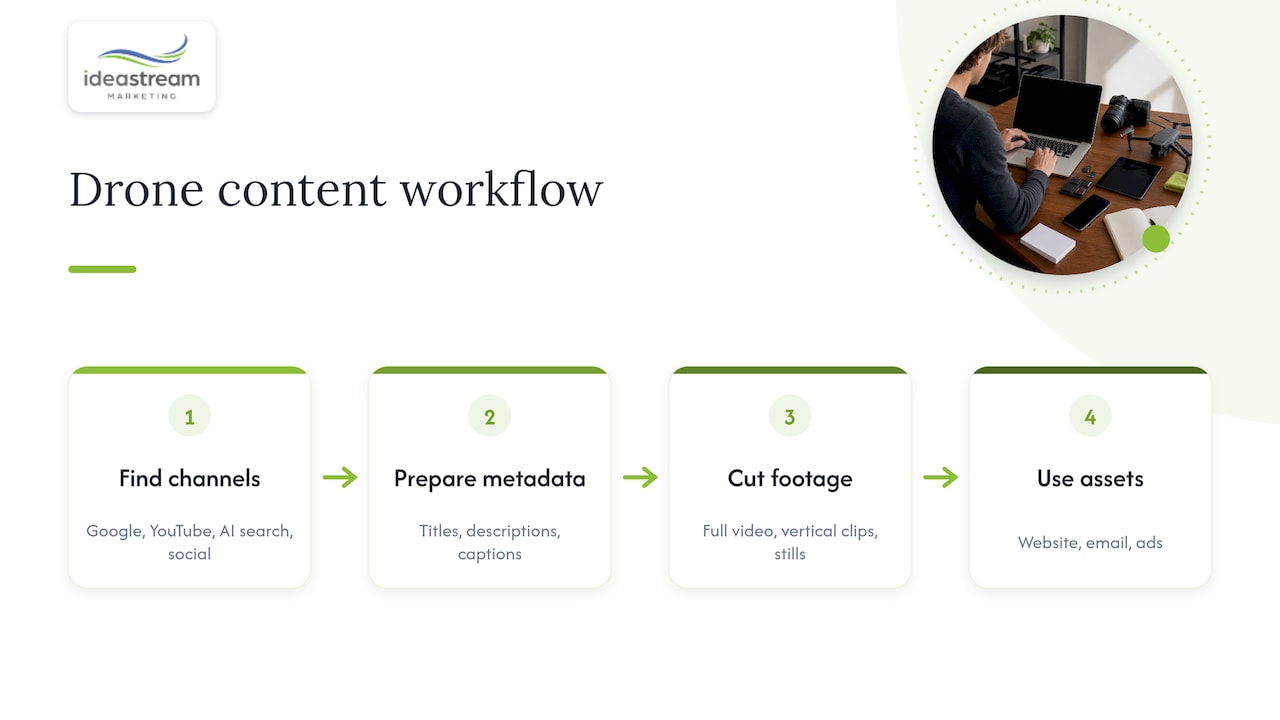
The second thing we push on is mixing aerial and ground-level work. Drone shots establish scale and place. Interviews, testimonials and product close-ups build trust. Together they turn a pretty clip into something that supports lead generation. If you also run a podcast, the same shoot day can produce episode B-roll and clips for repurposing.
Finally, we keep the measurement honest. A shot that looks great but does not lead to a call, a tour or a booking is a shot to cut next time.
— Dean Spinato, CEO & Founder of Idea Stream Marketing
Work with a Long Island video team
If you want aerial footage planned as part of a full video and marketing program, our drone videography services cover concept, filming, editing and delivery in the formats you need, and our Long Island video marketing and videography team can fold it into larger productions such as corporate video, photography and social content. Ready to talk through your project? SCHEDULE A CONSULTATION and tell us what you want the video to achieve.
FAQ
How can drones be used for marketing?
Businesses use drones for aerial imaging, event coverage and location-based storytelling, then publish the footage across websites, social media, email and ads. Common examples are property tours, homepage hero videos, construction progress reports and event recaps. The footage works hardest when it supports a specific goal, such as bookings or attendance.
How much does a drone video cost?
Published 2025 US rates run about $1,000 to $5,000 per project, with commercial marketing videos at $2,000 to $5,000, and real estate clips often between $100 and $700. Your price depends on the number of locations, flight time and how much editing, music and motion graphics you need. Ask for a quote that lists deliverables, such as the main video and vertical cuts.
Do I need a license to fly a drone for my business?
In the US, flying for business generally falls under FAA Part 107, which requires a Remote Pilot Certificate (or direct supervision by a certificate holder) and registration of the aircraft. Controlled airspace needs authorization. Ask any provider to confirm their certificate before the shoot.
Can I turn drone footage into Reels and Shorts?
Yes, and it is one of the best ways to get value from a shoot. Plan vertical framing in advance, then cut short clips with captions and a strong first second for Instagram Reels, Facebook Reels, TikTok and YouTube Shorts. Our social media video editing guide explains the workflow.
Is drone video worth it for a small business?
It is worth it when location, scale or setting is part of what you sell. Restaurants, venues, contractors, real estate firms and medical campuses often benefit most. If your service is mainly conversation or expertise, put the budget into interviews and testimonials first.
Sources
- Drone Enabled Marketing & Advertising (360iResearch)
- Small Unmanned Aircraft Systems (UAS) Regulations (Part 107), FAA
- Getting Started, FAA
- Part 107 Waivers, FAA
- Drone Services Pricing: A Guide to Pricing Your Drone Work, UAV Coach
- Drone Photography Pricing: What to Charge, Shotkit

