



October 14, 2026
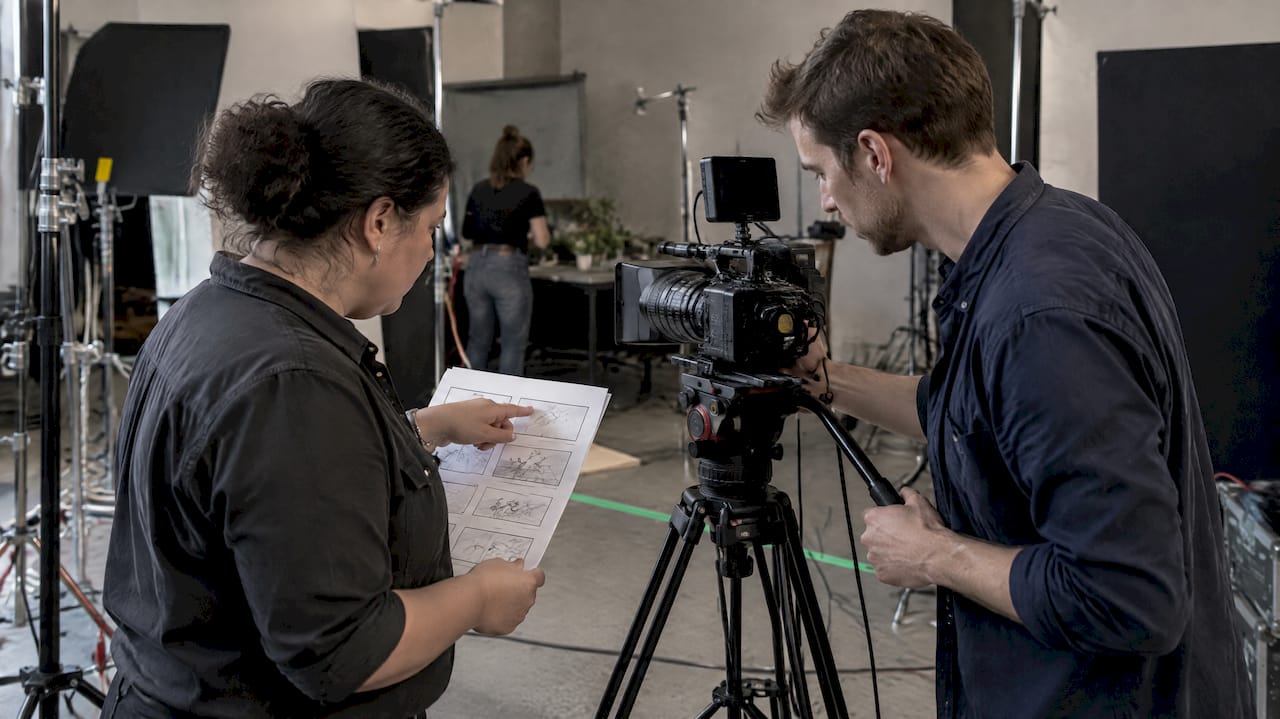
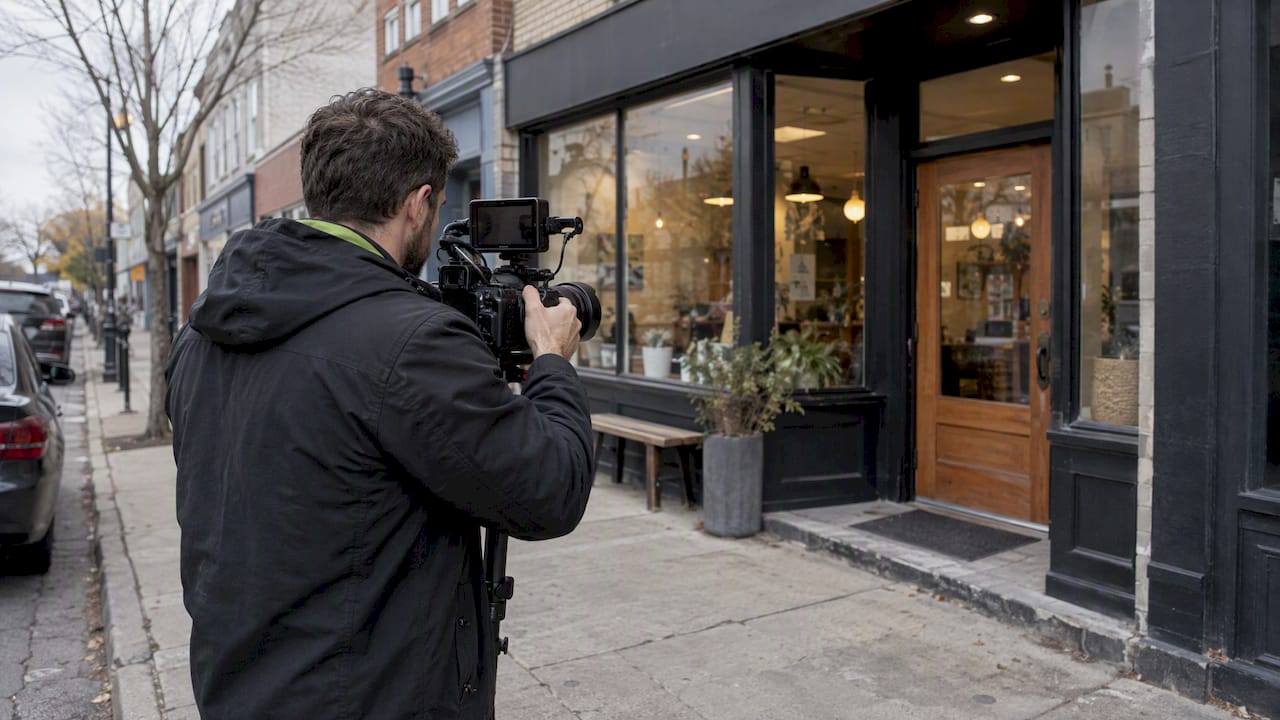

This page gathers video storyboard examples across the formats businesses actually produce, commercials, explainers, training videos, social clips, and narrative scenes, paired with ready-to-fill templates and a one-page checklist. You’ll see shot-by-shot breakdowns that explain what each panel teaches about coverage and pacing, plus the exact data points a panel needs before you hand it to a crew. Whether you’re planning your first shoot or tightening a workflow, this covers what makes a board usable on set and in the edit bay.
TL;DR:
- Each panel needs shot type, camera movement, action, audio, duration, and transition; movement arrows and overhead diagrams clarify blocking and protect screen direction.
- Choose formats by production: dense multirow boards suit animation and commercials, compact vertical boards suit social clips, and reorderable index cards fit evolving documentaries.
- For sequences involving stunts or uncertain performances, plan a wide static safety shot and cutaways so editors have usable coverage if the main take fails.
- Number storyboard panels and carry those identifiers into the shot list; revise both from one dated shared file, then review changes before each setup.
- Set aspect ratio and runtime first, map one panel to each story beat, then use a timed animatic with temporary audio to test pacing.
Table of Contents
- What Makes a Professional Storyboard Production-Ready
- Storyboard Examples by Use Case and Genre
- Storyboard Templates and How to Fill Them
- Shot List vs. Storyboard: Keeping Them in Sync
- Quick Professional Storyboard Checklist
- Tailoring Storyboards to Client Needs and Brand Messaging
- Styles and Formats Across Production Types
- Common Mistakes to Avoid When Designing Storyboards
- Tools and Software for Building Professional Storyboards
- How We Use Storyboards in Business Video Production
- Book a Storyboard or Studio Session with Idea Stream Marketing
- FAQ
- Sources
What Makes a Professional Storyboard Production-Ready
A storyboard earns its place on set by communicating a plan, not by looking polished. Storyboard artists who work in film consistently stress that the real skill is thinking like an editor, director, and director of photography at once: a board that looks beautiful but fails to show blocking or camera direction is worse than a rough stick-figure sketch that does its job, according to storyboarding guidance from Penn State.
Industry guidance on professional boards lays out exactly what belongs in every panel. According to storyboard examples curated for film production, each panel should include:
- Shot type: wide, medium, close-up, or extreme close-up, so the crew knows the framing before cameras roll.
- Camera movement: pan, tilt, dolly, or static, usually marked right on the frame.
- Action description: what happens in the frame, written plainly enough for a first assistant director to block it.
- Dialogue or sound cue: the line being delivered or the audio moment the shot needs to hit.
- Duration on screen: how long the shot runs, which keeps pacing honest before you ever reach the edit.
- Transition type: cut, dissolve, or wipe into the next panel, so editors inherit intent instead of guessing.
One detail separates a working board from a pretty one: annotated movement. Professionals mark camera-movement arrows, often in red, and character-movement arrows, often in blue, directly on the frame so a crew can see motion at a glance, a convention documented in storyboarding practice at Penn State. Many boards also pair each panel with an overhead location diagram showing camera placement relative to the subject, which keeps a shot list from accidentally breaking the 180-degree rule or planning an angle that’s physically impossible on location.
These aren’t decorative habits. Clear shot lists and storyboards reduce editing difficulty and on-set delays by locking down lighting needs, camera setups, and location logistics before the crew arrives, according to production planning guidance from Pixflow. A board also needs built-in insurance: experienced teams plan safety shots, wide coverage and cutaways, so a sequence still cuts together if a performance or stunt doesn’t land as planned. Think of the storyboard as the single document every department reads from: the DP checks lenses against it, the AD builds the schedule from it, and the editor uses it to anticipate coverage gaps before day one wraps.
Storyboard Examples by Use Case and Genre
Different video formats demand different storyboard logic. A commercial needs rhythm and a payoff shot; an explainer needs clarity beat by beat; a social reel needs a hook in the first second. Here’s how storyboard structure shifts across six common categories, with notes on what each example teaches and which template fits it.
1. Animation storyboards
Animated storyboards tend to run longer and denser than live-action boards because every frame has to be built from nothing, with no camera operator improvising on the day.
- Character-introduction sequence: a board establishing a lead character through a wide establishing shot, a medium reaction shot, and a close-up on a defining gesture, teaching how repeated framing builds a visual pattern before breaking it for emphasis.
- Dialogue exchange between two characters: alternating over-the-shoulder panels with eye-line notes, showing how animators plan shot-reverse-shot rhythm without a live set to referee eyelines.
- Transformation or reveal beat: a sequence that slows pacing with held frames before a fast cut, demonstrating timing control that only a frame-accurate board can plan in advance.
This category fits a multi-row, dense template since animated boards may need many panels to map an entire scene before storyboard-to-animatic handoff.
2. Commercials and ads
Commercial boards are built around a single payoff, usually a product shot or emotional beat near the end.
- Problem-solution structure: opens on a relatable frustration (medium shot, natural lighting cues noted), cuts to product introduction (close-up, clean background), and closes on a brand card, teaching compact pacing.
- Testimonial-style spot: a handheld medium shot of a speaker intercut with B-roll cutaways, showing how boards flag where supporting footage needs to land without disrupting the speaker’s rhythm.
- Lifestyle montage: a multi-row template stacking 6 to 8 quick shots to a music bed, demonstrating how boards handle rapid-cut sequences where duration notes matter more than dialogue cues.
A multi-row montage template suits this category because commercials often cram several locations and setups into a short runtime, and the row structure keeps setups grouped visually.
3. Explainer and training videos
Explainer boards prioritize clarity over style, since the goal is comprehension, not emotion.
- Screen-recording-plus-narration board: panels pairing on-screen text callouts with voice-over notes beneath each frame, a structure recommended for breaking training content into scenes with clear stage directions, per guidance from the Office of Community Oriented Policing Services.
- Step-by-step process demo: numbered panels matching numbered steps exactly, so editors can cut tightly to narration without re-timing footage later.
- Procedural or instructional sequence: a board built around clear learning outcomes and audiovisual quality, where preparing the storyboard, script, and shot list together before filming optimizes the entire recording phase, a practice detailed in tutorial guidance for health educators.
A multi-panel explainer template fits best here, since training content usually breaks into clean, discrete beats that map one-to-one with panels.
4. Branded social and short-form reels
Short-form storyboards compress everything into seconds, which means every panel earns its place.
- Hook-first vertical reel: panel one shows the hook moment, often a close-up with bold on-screen text, before the board ever introduces context, teaching creators to storyboard backward from the scroll-stopping frame.
- Before-and-after format: panels contrasting a starting state and a result, ideal for repurposing a longer interview or podcast clip into a TikTok video or Instagram Reel.
- Quick-tip carousel-to-video adaptation: panels mapped to on-screen text chunks, each timed to match the pace of the content, showing how vertical formats demand tighter duration notes than horizontal video.
A compact social template suits this category, since reels, Facebook Reels, and YouTube Shorts benefit from concise pacing and vertical framing.
5. Action sequences
Action boards need the most annotation because they coordinate the most moving parts: stunts, multiple cameras, and safety planning.
- Chase or pursuit sequence: panels marked with red camera-movement arrows and blue character-movement arrows on every frame, following the convention described in storyboarding practice at Penn State, so a stunt coordinator and camera operator read the same intent.
- Multi-camera coverage board: paired with an overhead location diagram placing each camera position relative to the action, preventing a setup that would cross the line and break continuity.
- High-stakes beat with safety shot: a wide, static safety angle storyboarded alongside the planned dynamic shot, guaranteeing usable footage if the primary setup doesn’t land.
This category calls for a board paired with a location diagram template rather than a standard panel grid, since spatial accuracy matters as much as shot sequence.
6. Documentary and interview coverage
Documentary boards plan less exact action and more flexible coverage, since real moments don’t hit marks on command.
- Sit-down interview setup: a board noting primary camera angle, a secondary cutaway angle, and B-roll insert points, built to be updated as the interview unfolds.
- Observational B-roll sequence: loose thumbnail panels prioritizing speed over polish, reflecting the practice of using rough sketches to test a sequence before committing a crew day to it, a method outlined in storyboarding tutorials from Dartmouth.
- Archival-plus-narration sequence: panels marking where archival footage intercuts with new interview material, with duration notes protecting pacing in the edit.
Because documentary shoots evolve on location, a flexible index-card template works better here than a locked grid: cards get reordered as footage and story needs shift.
Storyboard Templates and How to Fill Them
Choosing the right template starts with matching its structure to your runtime and aspect ratio, not the other way around.
- Compact social template: built for short vertical clips, best for a single-idea reel or ad.
- 6 to 8 panel explainer template: suited to tutorials and training videos where each panel maps to one step or concept.
- Multi-row commercial template: stacks rows of smaller panels for montage-heavy spots with several locations or setups.
- Index cards: a low-tech, highly flexible method where each card represents one shot; a common practice numbers cards for shots needed on a specific location and flips a card over to hold dialogue or transcript notes for quick on-set reference, a technique described in a storyboard example guide from California State University, Channel Islands.
Once you’ve picked a format, fill it in this order:
- Lock the aspect ratio and runtime first. A vertical reel and a horizontal commercial demand different panel shapes before you draw a single frame.
- Map your beats to panels. Break the script or outline into distinct story beats, then assign one panel per beat, adding more only where action genuinely changes.
- Add shot metadata to each panel. Camera movement, duration, and audio cue go directly on or beneath the frame, matching the minimum data standard outlined in professional storyboard examples.
- Flag priority. Mark each panel must-have or nice-to-have, so a crew pressed for time on location knows what to protect first.
Once the board is filled, many productions convert it into an animatic, a rough edit of the panels in sequence with timing and temp audio, to test pacing before a single frame is shot. Export the final board as a timecoded PDF so every department works from the same numbered reference. Editable templates with fields for scene, voice-over, on-screen text, and director’s notes are available as free downloadable resources from the Ohio Department of Mental Health and Addiction Services, and remain a solid starting point for teams building their first board from scratch.
Pro Tip: Keep your first pass rough and fast. Thumbnail every beat quickly, then only polish the frames you’ll actually show a client.
Shot List vs. Storyboard: Keeping Them in Sync
A storyboard shows what each shot looks like; a shot list tells the crew the order to shoot them in, along with the technical specs needed to execute each one. They serve different audiences on the same production day, and keeping them aligned prevents the most common source of on-set confusion.
The translation from board to list follows a consistent path:
- Number each panel, then carry that number into the scene and shot numbering on the shot list, so nobody loses track of which board frame a line item refers to.
- Add camera specs to the shot list that the storyboard only implies: lens choice, camera height, and exact blocking notes for talent.
- Build the animatic from the numbered panels to confirm pacing before the shot list gets locked.
- Generate the lined script, marking where each numbered shot falls within the dialogue or action.
- Finalize the shot list, now carrying scene number, shot number, lens, movement, and blocking inherited directly from the storyboard.
- Distribute the call sheet, referencing shot numbers so every department arrives knowing the day’s order.
This sequence matters because storyboarding is inherently iterative. Shot lists and storyboards both get revised as schedules, budgets, or locations shift, and the board should be treated as a flexible blueprint, finalized only after production meetings with the director and director of photography, according to screenwriting and pre-production guidance from Fitchburg State University. The most common synchronization pitfall is a crew working from an outdated board while someone else has already revised the shot list. Version control, a single shared file with a visible revision date, and a quick on-set review before each setup both catch mismatches before they cost a take.
Quick Professional Storyboard Checklist
Copy these fields into any template before you start filling panels, so nothing critical gets left off a frame.
- Panel number
- Shot type (wide, medium, close-up, extreme close-up)
- Camera movement (pan, tilt, dolly, static)
- Action description
- Dialogue or sound cue
- Duration on screen
- Transition to next panel
- Lens and camera height notes
- Continuity and prop notes
- Priority flag (must-have vs. nice-to-have)
Always schedule a wide safety shot and a small set of cutaways for every sequence with movement or performance risk, insurance that protects the edit if a planned shot doesn’t cut cleanly.
| Format | Typical pacing heuristic |
|---|---|
| Short-form social (Reels, TikTok, Shorts) | Brief pacing per panel |
| Explainer or training video | One beat per panel, with timing suited to the content |
| Commercial or ad | Brief pacing per panel in montage sections |
| Documentary or interview | Flexible, panels adjusted after each setup |
Tailoring Storyboards to Client Needs and Brand Messaging
A storyboard built for an internal training video looks different from one built for a client-facing brand campaign, and the difference starts with whose voice the board protects. For client work, map every panel back to a messaging pillar before a frame gets sketched: does this shot reinforce trust, demonstrate expertise, or move a viewer toward a specific action? Dialogue and sound cue fields on each panel should mirror approved brand language, not placeholder copy, so there’s no surprise when the script gets locked.
Client-facing boards can benefit from an extra review layer. Pacing, visual tone, and camera angle choices can be reviewed with the client before production day. A markup pass, where the client annotates panels directly rather than giving verbal notes, can keep revisions trackable and help prevent miscommunication from surviving into the edit. The goal is a board that reads as a shared document between agency and client.
Styles and Formats Across Production Types
The right storyboard format depends entirely on what you’re producing, and treating every project with the same template wastes time. Animation demands dense boards because every frame must be built from nothing with no camera operator to improvise coverage on the day. Live-action commercials and branded content lean on multi-row, compact templates that group locations or setups visually, since a short spot may touch several different scenes.
Documentary and interview-based projects need the loosest structure of all. Because real moments don’t hit marks on cue, a documentary board works better as a flexible index-card system that gets reordered as footage comes in, rather than a locked grid finalized before day one. Short-form social content sits at the opposite extreme: rigid and compact, built backward from the hook moment rather than forward from an establishing shot. Choosing the wrong format, a loose documentary-style board for a tightly timed TikTok video, or a rigid 8-panel grid for a documentary, creates friction that shows up as wasted time either in planning or on location.

Common Mistakes to Avoid When Designing Storyboards
The most frequent mistake is treating the storyboard as fine art instead of a functional instruction set. A beautifully rendered panel that fails to show camera direction or blocking gives a crew less to work with than a rough stick-figure sketch with clear movement arrows.
A few other patterns show up repeatedly:
- Skipping duration notes. Without an estimated time on screen for each panel, pacing problems don’t surface until the edit, when they’re expensive to fix.
- Leaving out safety shots. A board with no wide coverage or cutaway plan leaves an editor stuck if the primary take has a problem.
- Ignoring the 180-degree rule. Without an overhead location diagram showing camera placement, it’s easy to plan a reverse angle that breaks screen direction.
- Treating the board as final on first draft. Storyboards are meant to evolve through production meetings with the director and DP, and locking one too early invites on-set improvisation that the plan should have prevented.
Tools and Software for Building Professional Storyboards
Storyboard tools range from paper to full digital suites, and the right choice depends on how fast your production moves and how many people need to review the board. Index cards remain a legitimate low-tech option, especially for documentary work where shots get reordered often. Many teams start with free editable templates that include fields for scene description, voice-over text, on-screen notes, and visual references, which keep nontechnical team members from needing special software to contribute a usable draft.
Digital storyboard and animatic software adds timing controls, drag-and-drop panel reordering, and direct export to timecoded PDF, useful once a project moves past the thumbnail stage and needs to go to a full crew. Screen-recording and slide-based tools work well for explainer and training content, where panels often pair directly with on-screen text callouts. Whatever the tool, the standard doesn’t change: every panel still needs shot type, movement, action, audio cue, duration, and transition noted clearly enough that someone who wasn’t in the planning meeting can still execute it correctly.
How We Use Storyboards in Business Video Production
We treat the storyboard as the document that decides whether a shoot day runs smoothly or runs long. A project can start with concept development, move into a storyboard that maps shot type, movement, and timing panel by panel, and then be reviewed before a camera rolls. For business clients, a storyboard can plan the final deliverable and its repurposed versions at the same time: a long-form cut and vertical clips for social platforms.
Business storyboards carry priorities a narrative board doesn’t: where the hook lands, which frame becomes the thumbnail, and how title-card timing supports search visibility once the video publishes. If you want a second set of eyes on a storyboard or an animatic before your next shoot, our team can discuss the plan with you.
Book a Storyboard or Studio Session with Idea Stream Marketing
We help turn storyboards into video, so you’re not stuck translating a plan into footage on your own. Our team can help with storyboard and animatic development, video production and editing, and social repurposing.
- Storyboard and animatic planning to work out pacing before production.
- Video production, including scripting, filming, and editing.
- Social repurposing into Instagram Reels, Facebook Reels, TikTok videos, and YouTube Shorts from a single shoot.
- Podcast recording and editing, with episodes cut into shareable clips for ongoing content.
Working with a studio means technical validation on your board before you commit a crew day to it, and deliverables built with search visibility in mind from the first panel. If your business is planning a commercial, training video, or podcast series, visit our video production services page or explore video in advertising to see how a storyboard turns into a finished campaign. Ready to put a plan on paper? Reach out through our main services page to schedule a consultation or studio session.
FAQ
What is a video storyboard called?
A video storyboard is also called a shot board or visual script, since it maps shots and scenes in sequence before filming begins. Some productions also refer to a rough first pass as a thumbnail board, before it’s filled in with full shot metadata.
What does a good storyboard look like?
A good storyboard reads as a functional instruction set rather than polished art, with every panel showing shot type, camera movement, action, dialogue or sound cue, duration, and transition, standards outlined in professional storyboard guidance. Strong boards also include movement arrows and an overhead location diagram so a crew can plan blocking without guesswork.
Where can I find a free video storyboard template?
Free editable storyboard templates with fields for scene, voice-over text, on-screen notes, and visual examples are available from sources like the Ohio Department of Mental Health and Addiction Services. Our video content checklist also complements a storyboard template with broader asset planning for marketing teams.
What are the three types of storyboards?
Storyboard formats generally fall into three practical categories: panel-grid boards for scripted sequences, index-card boards for flexible shoots like documentaries, and animatic boards that add timing and temp audio to test pacing before filming. Each format trades off detail for speed depending on how much the production is likely to change on location.
How do shot lists and storyboards work together on set?
A storyboard shows what each shot looks like, while a shot list tells the crew the order to film them in along with lens, movement, and blocking details. Panel numbers from the storyboard typically carry directly into the shot list’s scene and shot numbering, a workflow detailed in pre-production planning guidance from Fitchburg State University.
— Dean Spinato, CEO & Founder of Idea Stream Marketing